
The Scrapbook — No. 29
4 short stories by Franz Kafka, Jorge Luis Borges, Ernest Hemingway and Roberto Bolaño

Because there aren't many better ways to spend ten minutes.
A Message from the Emperor, Franz Kafka

The emperor—it is said—sent to you, the one apart, the wretched subject, the tiny shadow that fled far, far from the imperial sun, precisely to you he sent a message from his deathbed. He bade the messenger kneel by his bed, and whispered the message in his ear. So greatly did he cherish it that he had him repeat it into his ear. With a nod of his head he confirmed the accuracy of the messenger’s words. And before the entire spectatorship of his death—all obstructing walls have been torn down and the great figures of the empire stand in a ring upon the broad, soaring exterior stairways—before all these he dispatched the messenger. The messenger set out at once; a strong, an indefatigable man; thrusting forward now this arm, now the other, he cleared a path though the crowd; every time he meets resistance he points to his breast, which bears the sign of the sun; and he moves forward easily, like no other. But the crowds are so vast; their dwellings know no bounds. If open country stretched before him, how he would fly, and indeed you might soon hear the magnificent knocking of his fists on your door. But instead, how uselessly he toils; he is still forcing his way through the chambers of the innermost palace; never will he overcome them; and were he to succeed at this, nothing would be gained: he would have to fight his way down the steps; and were he to succeed at this, nothing would be gained: he would have to cross the courtyard and, after the courtyard, the second enclosing outer palace, and again stairways and courtyards, and again a palace, and so on through thousands of years; and if he were to burst out at last through the outermost gate—but it can never, never happen—before him still lies the royal capital, the middle of the world, piled high in its sediment. Nobody reaches through here, least of all with a message from one who is dead. You, however, sit at your window and dream of the message when evening comes.
Translated by Mark Harman
The Humanities Library has a community of 22,000 followers and over 9,000 subscribers, all of them drawn to philosophy, art, literature, and the strange corners of human experience. If that sounds like you, a paid subscription unlocks the full archive, where we go into far more depth on related themes and ideas.
Borges and I, Jorge Luis Borges
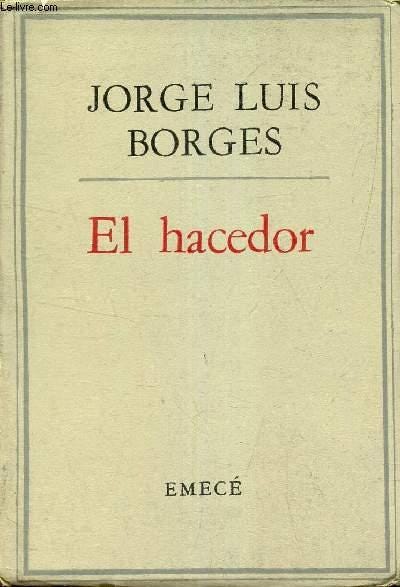
The other one, Borges, is the one things happen to. I wander around Buenos Aires, pausing perhaps unthinkingly, these days, to examine the arch of an entranceway and its metal gate. I hear about Borges in letters, I see his name on a roster of professors and in the biographical gazetteer. I like hourglasses, maps, eighteenth-century typeface, the taste of coffee, and Stevenson’s prose. The other one likes the same things, but his vanity transforms them into theatrical props. To say that our relationship is hostile would be an exaggeration: I live, I stay alive, so that Borges can make his literature, and this literature is my justification. I readily admit that a few of his pages are worthwhile, but these pages are not my salvation, perhaps because good writing belongs to no one in particular, not even to my other, but rather to language and tradition. As for the rest, I am fated to disappear completely, and only a small piece of me can possibly live in the other one. I’m handing everything over to him bit by bit, fully aware of his nasty habit of distortion and aggrandizement. Spinoza knew that all things desire to endure in their being: stones desire to be stones, and tigers tigers, for all eternity. I must remain in Borges rather than in myself (if in fact I am a self), and yet I recognize myself less in his books than in many others, or in the rich strumming of a guitar. Some years ago I tried to get away from him: I went from suburban mythologies to playing games with time and infinity. But these are Borges’ games now—I will have to think of something else. Thus my life is an escape. I will lose everything, and everything will belong to oblivion, or to the other.
I don’t know which of us wrote this.
Translated by Kenneth Krabbenhoft
A Very Short Story, Ernest Hemingway
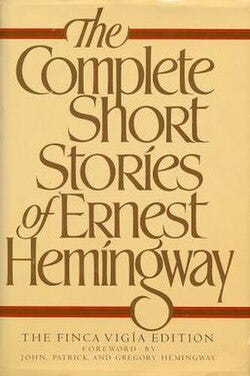
One hot evening in Padua they carried him up onto the roof and he could look out over the top of the town. There were chimney swifts in the sky. After a while it got dark and the searchlights came out. The others went down and took the bottles with them. He and Luz could hear them below on the balcony. Luz sat on the bed. She was cool and fresh in the hot night.
Luz stayed on night duty for three months. They were glad to let her. When they operated on him she prepared him for the operating table; and they had a joke about friend or enema. He went under the anaesthetic holding tight on to himself so he would not blab about anything during the silly, talky time. After he got on crutches he used to take the temperatures so Luz would not have to get up from the bed. There were only a few patients, and they all knew about it. They all liked Luz. As he walked back along the halls he thought of Luz in his bed.
Before he went back to the front they went into the Duomo and prayed. It was dim and quiet, and there were other people praying. They wanted to get married, but there was not enough time for the banns, and neither of them had birth certificates. They felt as though they were married, but they wanted everyone to know about it, and to make it so they could not lose it.
Luz wrote him many letters that he never got until after the armistice. Fifteen came in a bunch to the front and he sorted them by the dates and read them all straight through. They were all about the hospital, and how much she loved him and how it was impossible to get along without him and how terrible it was missing him at night.
After the armistice they agreed he should go home to get a job so they might be married. Luz would not come home until he had a good job and could come to New York to meet her. It was understood he would not drink, and he did not want to see his friends or anyone in the States. Only to get a job and be married. On the train from Padua to Milan they quarreled about her not being willing to come home at once. When they had to say good-bye, in the station at Milan, they kissed good-bye, but were not finished with the quarrel. He felt sick about saying good-bye like that.
He went to America on a boat from Genoa. Luz went back to Pordonone to open a hospital. It was lonely and rainy there, and there was a battalion of arditi quartered in the town. Living in the muddy, rainy town in the winter, the major of the battalion made love to Luz, and she had never known Italians before, and finally wrote to the States that theirs had only been a boy and girl affair. She was sorry, and she knew he would probably not be able to understand, but might some day forgive her, and be grateful to her, and she expected, absolutely unexpectedly, to be married in the spring. She loved him as always, but she realized now it was only a boy and girl love. She hoped he would have a great career, and believed in him absolutely. She knew it was for the best.
The major did not marry her in the spring, or any other time. Luz never got an answer to the letter to Chicago about it. A short time after he contracted gonorrhea from a sales girl in a loop department store while riding in a taxicab through Lincoln Park.
The Secret of Evil, Roberto Bolaño
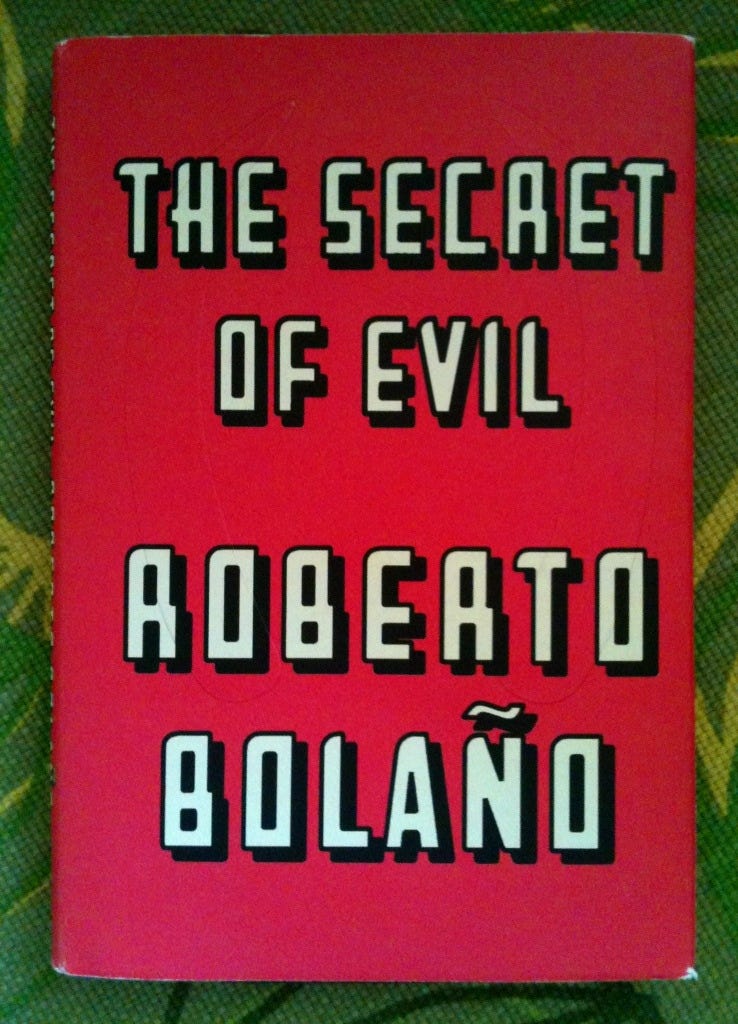
This story is very simple, although it could have been very complicated. Also, it’s incomplete, because stories like this don’t have an ending. It’s night in Paris, and a North American journalist is sleeping. Suddenly the telephone rings, and someone asks in English, with an unidentifiable accent, for Joe A. Kelso. Speaking, says the journalist and then looks at his watch. It’s four in the morning; he’s only had about three hours’ sleep and he’s tired. The voice on the other end of the line says, I have to see you, to pass on some information. The journalist asks him what it’s about. As usual with calls like this, the voice gives nothing away. The journalist asks for some indication, at least. In impeccable English, far more correct than Kelso’s, the voice expresses a preference for a face-to-face meeting. Then, straight away, it adds, There is no time to lose. Where? Kelso asks. The voice mentions one of the bridges over the Seine. And adds: You can get there in twenty minutes on foot. The journalist, who has had hundreds of meetings like this, says that he’ll be there in half an hour. Getting dressed, he thinks it’s a pretty stupid way to waste the night, and yet he realizes, with a slight shock of surprise, that he’s no longer sleepy, that the call, in spite of its predictability, has left him wide awake. When he reaches the bridge, five minutes after the appointed time, he can see nothing but cars. For a while he stands still at one end, waiting. Then he walks across the bridge, which is still deserted, and after waiting for a few minutes at the other end, finally crosses back again and decides to give up and go home to bed. While he’s walking home, he thinks about the voice: it definitely wasn’t a North American voice and it probably wasn’t British either, though he’s not so sure about that now. It could have been a South African or an Australian, he thinks, or a Dutchman, maybe, or someone from northern Europe who learned English at school and has since perfected his command of the language in various Anglophone countries. As he crosses the street he hears someone call his name: Mr. Kelso. He realizes straight away that it’s the man who arranged to meet him on the bridge, speaking from a dark entranceway. Kelso is about to stop, but the voice instructs him to keep walking. When he reaches the next corner, he turns around and sees that no one is following him. He’s tempted to retrace his steps, but after a moment’s hesitation he decides that it’s best to continue on his way. Suddenly the man appears from a side street and greets him. Kelso returns his greeting. The man holds out his hand. Sacha Pinsky, he says. Kelso shakes his hand and introduces himself in turn. Pinsky pats him on the back and asks if he’d like a whiskey. A little whiskey, is what he actually says. He asks Kelso if he’s hungry. He assures the journalist that he knows a bar where they can get hot croissants, freshly baked. Kelso looks at his face. Although Pinsky is wearing a hat, his face is a pasty white, as if he’d been locked away for years and years. But where? Kelso wonders. In a prison or an institution for the mentally ill. In any case, it’s too late to pull out now, and Kelso wouldn’t mind a hot croissant. The place is called Chez Pain, and in spite of the fact that it’s in his neighborhood (in a narrow side street, admittedly), this is the first time he’s set foot inside, and perhaps the first time he’s even seen it. Mostly he frequents establishments in Montparnasse with a dubious air of legend about them: the place where Scott Fitzgerald once ate, the place where Joyce and Beckett drank Irish whiskey, the bars favored by Hemingway and Dos Passos, Truman Capote and Tennessee Williams. Pinsky was right about the croissants at Chez Pain: they’re good, they’re freshly baked, and the coffee isn’t bad at all. Which makes Kelso think—and it’s a chilling thought—that this guy could well be a local, a neighbor. As he considers this possibility, Kelso is seized by a shudder. A bore, a paranoiac, a madman, a watcher with no one to watch him in turn, someone it’s going be hard to get rid of. Well, he eventually says, I’m listening. The pale man, who is sipping his coffee but not eating, looks at him and smiles. There is something intensely sad about his smile, and tired as well, as if it were the only way in which he could allow himself to express his tiredness, his exhaustion and lack of sleep. But as soon as he stops smiling, his features recover their iciness.
Translated by Chris Andrews
That's all until next time!