
The Scrapbook — No. 27
Wine, Medieval Execution and Gothic Architecture

Following a thread taking us from French obsession with wine to gothic architecture, via a medieval execution method. You might know as many as eight new things in a few minutes time. Is this what we call flourishing? I suspect probably not.
1 - We'll start with Roland Barthes, who's Mythologies is on my coffee table at the moment (a recent charity shop purchase owing to fond undergraduate memories). He raised a smile with this section on wine which, in his telling, appears to be something like a totalitarian social contract in France:
“A Frenchman who kept this myth at arm's length would expose himself to minor but definite problems of integration, the first of which, precisely, would be that of having to explain his attitude. The universality principle fully applies here, inasmuch as society calls anyone who does not believe in wine by names such as sick, disabled or depraved: it does not comprehend him (in both senses, intellectual and spatial, of the word). Conversely, an award of good integration is given to whoever is a practising wine-drinker: knowing how to drink is a national technique which serves to qualify the French-man, to demonstrate at once his performance, his control and his sociability. Wine gives thus a foundation for a collective morality, within which everything is redeemed: true, excesses, misfortunes and crimes are possible with wine, but never viciousness, treachery or baseness; the evil it can generate is in the nature of fate and therefore escapes penalization, it evokes the theatre rather than a basic temperament.”
2 - It’s interesting that sixty years before Barthes’ essay, French wine had almost ceased to exist.
In the 1860s, a tiny aphid-like louse called phylloxera arrived in France on imported American vine cuttings. It had no quarrel with American roots, which had long since learned to tolerate it, but European vines had no such immunity. Within two decades, it had eaten through roughly two-thirds of French wine production, forcing the government to offer 300,000 francs to whoever could stop it.
The solution, when it came, was to graft European vines onto American rootstock, which had evolved resistance to the louse. And it worked. Every bottle of French wine produced since the 1880s has, at its root (no pun intended) an American foundation.
I learnt this at a wine tasting years ago and reading Barthes on French attitudes to wine brought it back to mind. I do wonder what he’d make of the story.
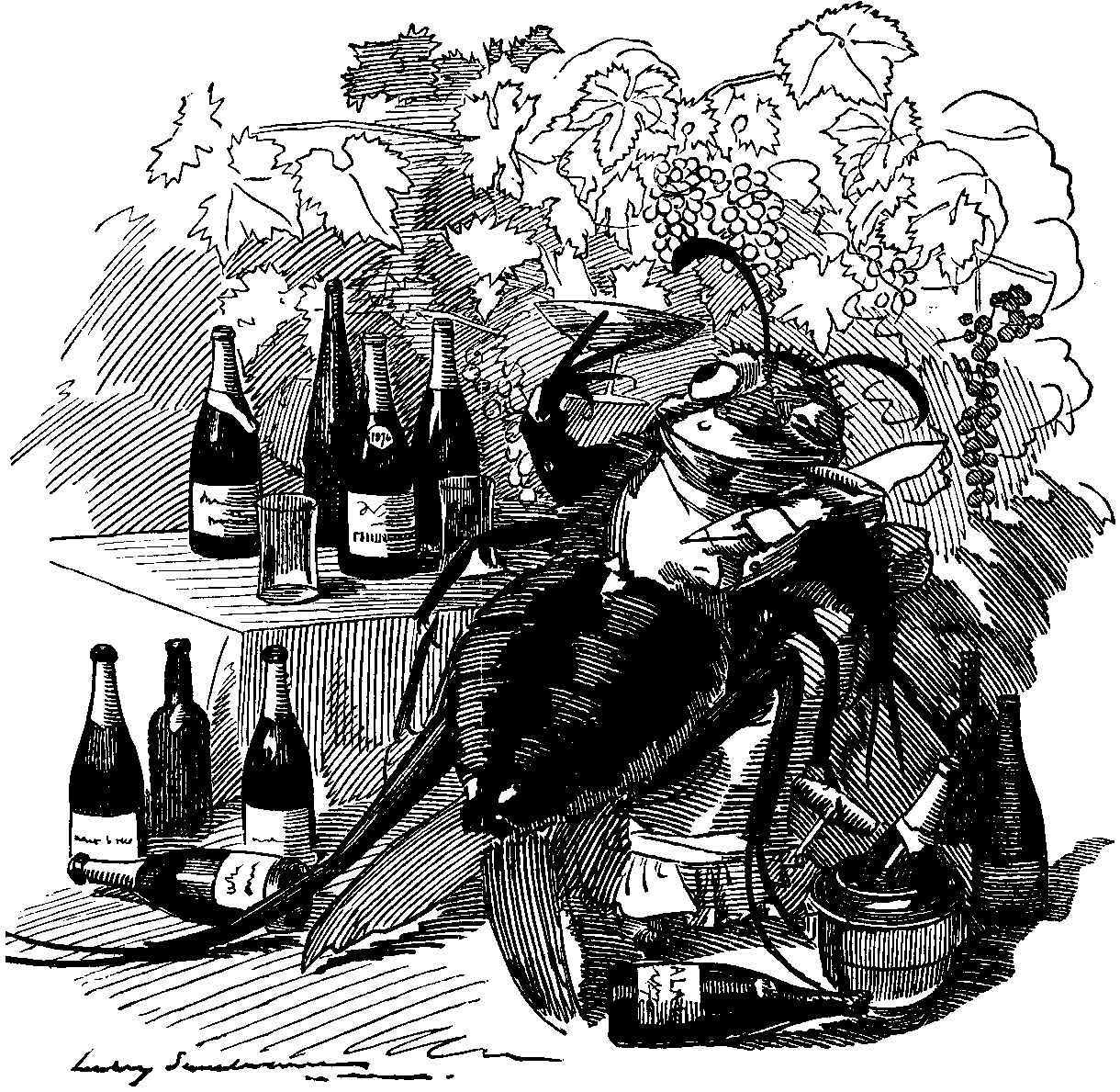
A cartoon from Punch from 1890: The phylloxera, a true gourmet, finds out the best vineyards and attaches itself to the best wines.
The Humanities Library has a community of 20,000 followers and over 8,000 subscribers, all of them drawn to philosophy, art, literature, and the strange corners of human experience. If that sounds like you, a paid subscription unlocks the full archive, where we go into far more depth on related themes and ideas.
3 - Fernand Braudel, the great French historian and a leader of the Annales School, which focused on social, as opposed to political or diplomatic, histories, tells the following anecdote in his The Structure of Everyday Life, which points similarly towards the French preoccupation with wine.
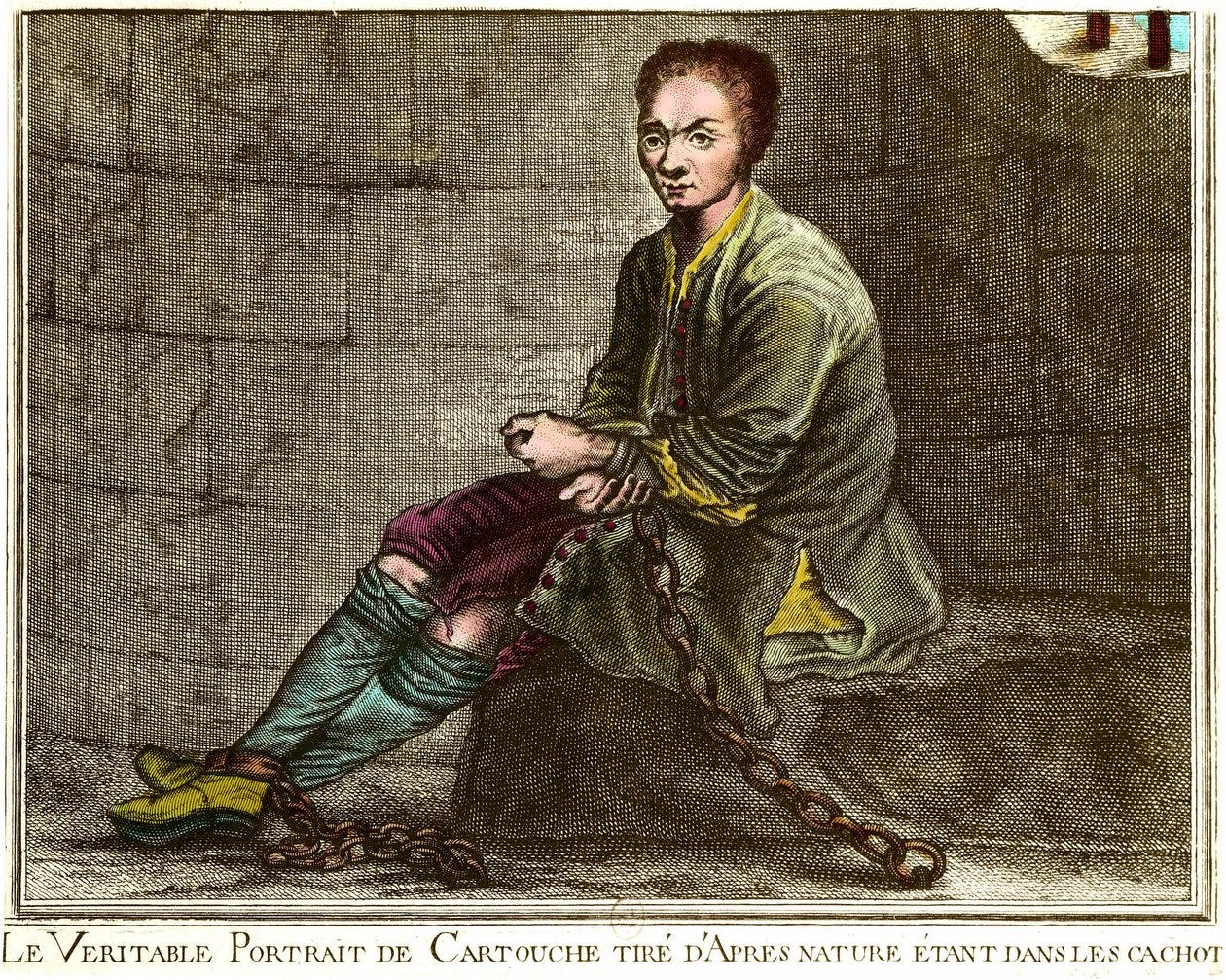
When Louis Dominique Bourguignon, nicknamed Cartouche, was about to be put to death (broken on the wheel: more on that later) in November 1721, his ‘judge’ who was drinking white coffee apparently offered him a cup. He replied, in fabulously French fashion, that this was “not his drink” and that he would “prefer a glass of wine with a little bread.”
Who could argue?
4 - Cartouche, incidentally, is a kind of French Robin Hood figure; a highwayman reported to steal from the rich and give to the poor in the environs of Paris during the Régence.
5 - The breaking wheel in question was a large wooden cartwheel to which the condemned was tied whilst the executioner worked through the body systematically with a heavy iron bar, breaking the major bones in sequence. Legs first, typically, then arms, then the torso. The number of blows was sometimes written into the sentence itself. A merciful sentence began at the chest. A less merciful one started at the feet and took its time. The broken body was then left on the wheel, raised on a post, for public display.
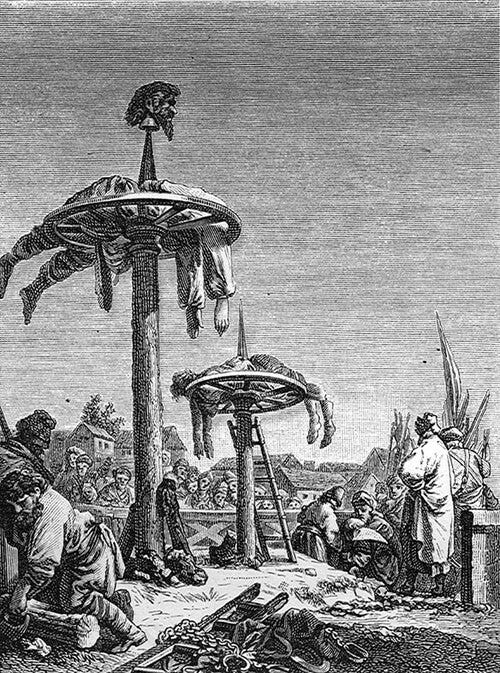
Executions, by breaking wheel, of Cossacks by Russian troops in Baturyn or Lebedyn, 1708–1709
6 - St. Catherine of Alexandria was the most famous victim of this brutal practice, sentenced to be executed on one of these breaking wheels for refusing to renounce her Christian belief. This was enormously inconvenient for her executioners and gave the “Catherine wheel” its name. It was, however, only a temporary reprieve. They beheaded her instead, which no amount of miraculous intervention seemed forthcoming to prevent.
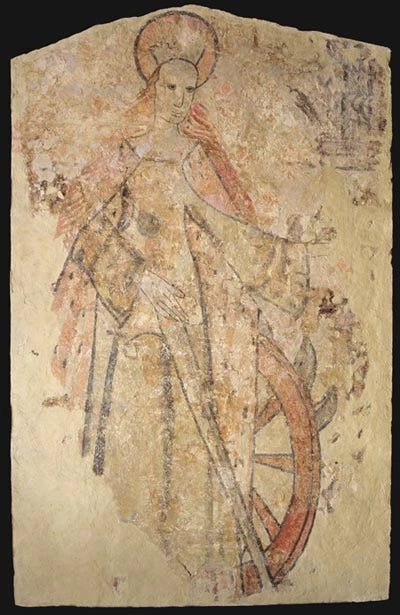
Medieval wall painting of St Catherine, from St Teilos church, dating to around 1400.
7 - This is also where those fizzing little firework wheels get their name, so you may bore your family next bonfire night, as I intend to, with some medieval history. In my experience, the Catherine wheel firework shares at least one quality with its medieval namesake: a notable tendency to fail at the critical moment. There’s a pleasing consistency in that, at least, which might temper the misery of watching a damp firework that just sits there angrily for a few seconds before giving up.
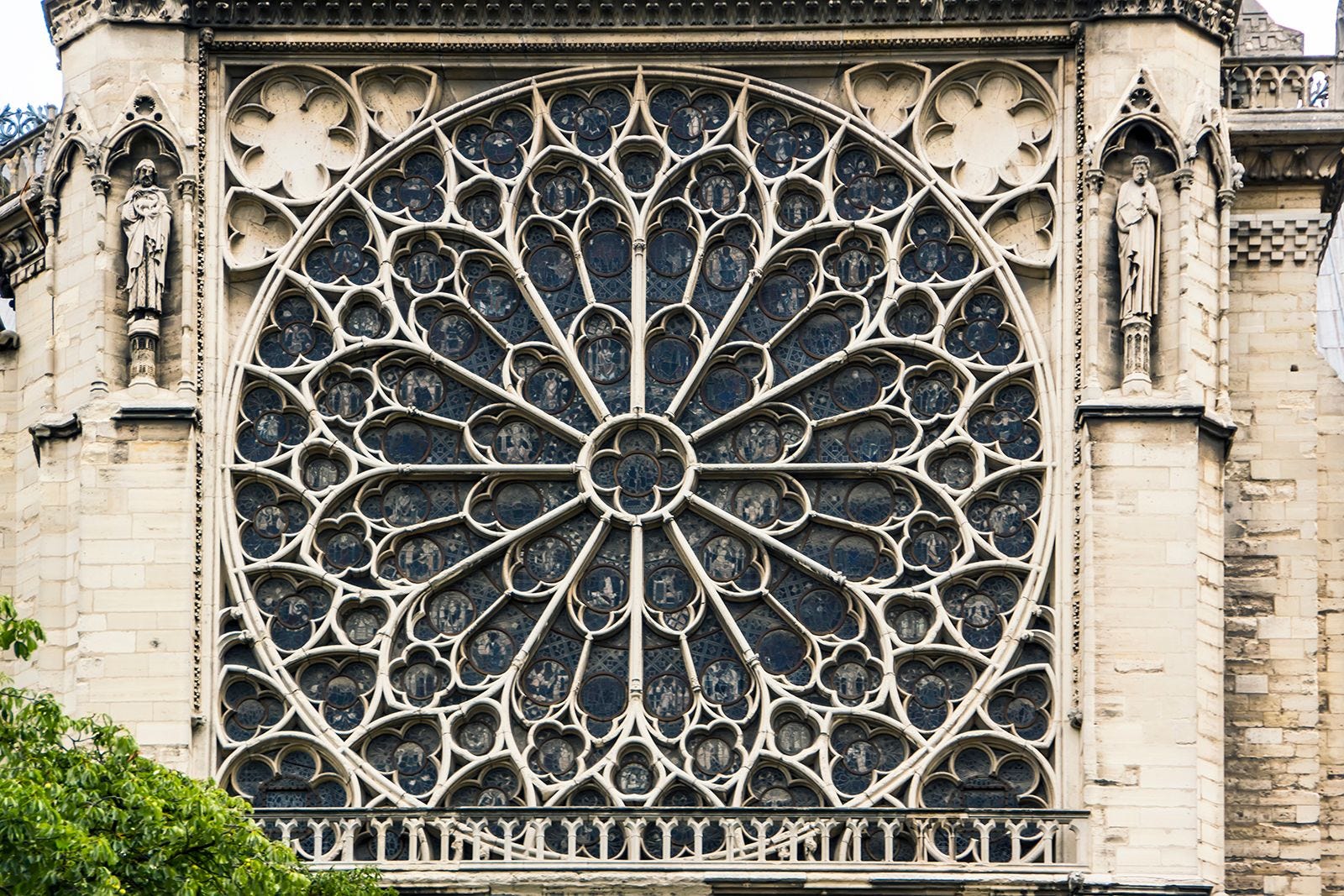
8 - I promised I’d bring you round to gothic architecture by the end, and I’m a man of my word. These rose windows that are such a popular feature of the style; they’re often called Catherine wheels for the same reason.
I don’t know what I’m doing with my life.
All the best until next time
You are bringing joy! This was fascinating and gruesome and extraordinary to know. Thank you!