
The Scrapbook — No. 25
7 things you might not have known about David Hockney, plus a poem to remember him with

Tracey Emin, on learning of her friend’s death this week, described the late David Hockney as “a great artist and a wonderful man, who with the power of art changed the perception of Britishness. A proud chain-smoking homosexual, who flew the flag higher than any other British artist.” There are many fine obituaries doing the rounds, but that’s the best I’ve come across. Let’s mourn the loss of a great with a few celebratory notes on a fascinating life.
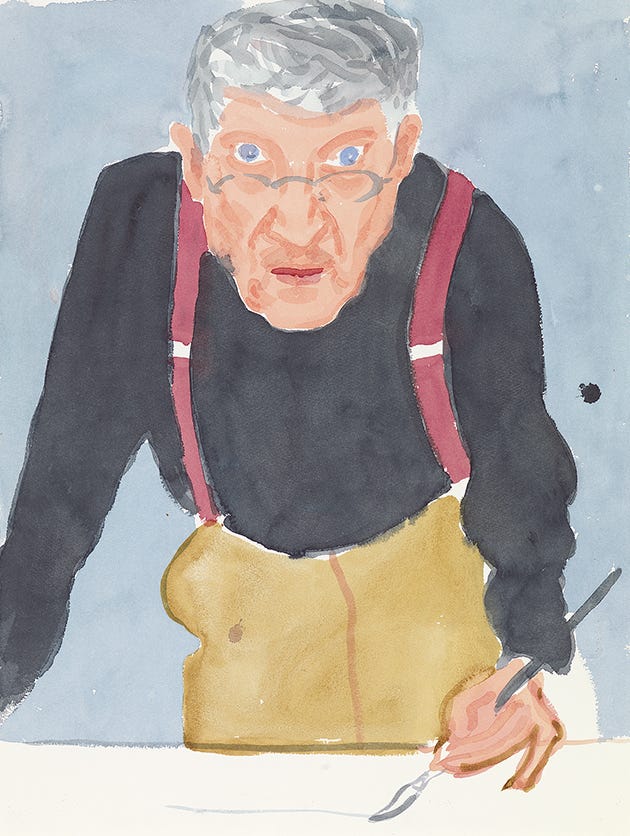
Self Portrait with Red Braces, 2003
The Humanities Library has a community of 20,000 followers and over 8,000 subscribers, all of them drawn to philosophy, art, literature, and the strange corners of human experience. If that sounds like you, a paid subscription unlocks the full archive, where we go into far more depth on related themes and ideas.
1 - He failed his exams deliberately. At his Bradford secondary school in the early 1950s, academically promising boys were required to drop art as a subject. It was the serious stuff that awaited them. So Hockney, already certain at fifteen that he was going to be a painter, sat his exams and underperformed on purpose. The plan worked; he was allowed to keep studying art. I’ll go out on a limb and say that this was a good thing. I wish I could report on an updated attitude towards the arts in the secondary schools of 2026.
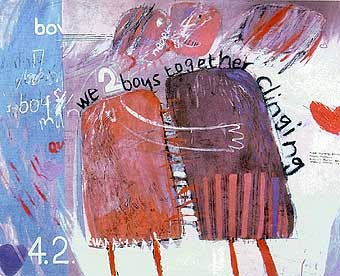
2 - He described his early paintings as “homosexual propaganda.” He came out publicly at twenty-three, in 1960, when homosexuality was still a criminal offence in England. His early canvases featured naked men, lovers in beds, and figures drawn from physique magazines. They were produced at a moment when virtually no visible queer imagery existed in British fine art. Works like We Two Boys Together Clinging (1961), titled after a Walt Whitman poem, made male intimacy explicit at a time when such things were genuinely illegal.
3 - He stole a book of poems from Bradford Public Library. As a teenager, Hockney discovered C.P. Cavafy in his local library and liked him so much that he pocketed the copy and never returned it. In 1966, living in California by then, he produced Illustrations for Fourteen Poems by C.P. Cavafy: etchings depicting young male couples, tender and unashamed, in bed together. He was making explicit what the poems only hinted at. He even travelled to Beirut that year in search of the atmosphere of Cavafy’s Alexandria.


4 - He invented a “Wagner drive” along the Pacific Coast Highway. He once said he didn’t merely love Wagner; he was addicted to Wagner. He attended the Bayreuth Festival three times, and at his Malibu beach house he began plotting driving routes along the PCH timed to specific Wagner selections. He called this his “Wagner Drive,” a private audiovisual artwork performed for guests in his red convertible Mercedes. “You’d come around a corner,” he said, “and as the music rose you’d see the setting sun suddenly revealed.”
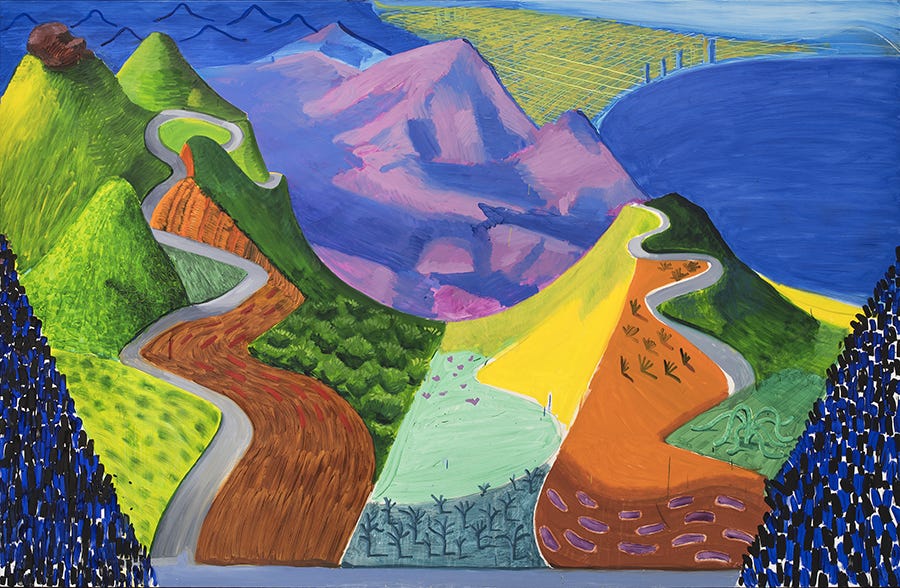
Pacific Coast Highway and Santa Monica, 1990
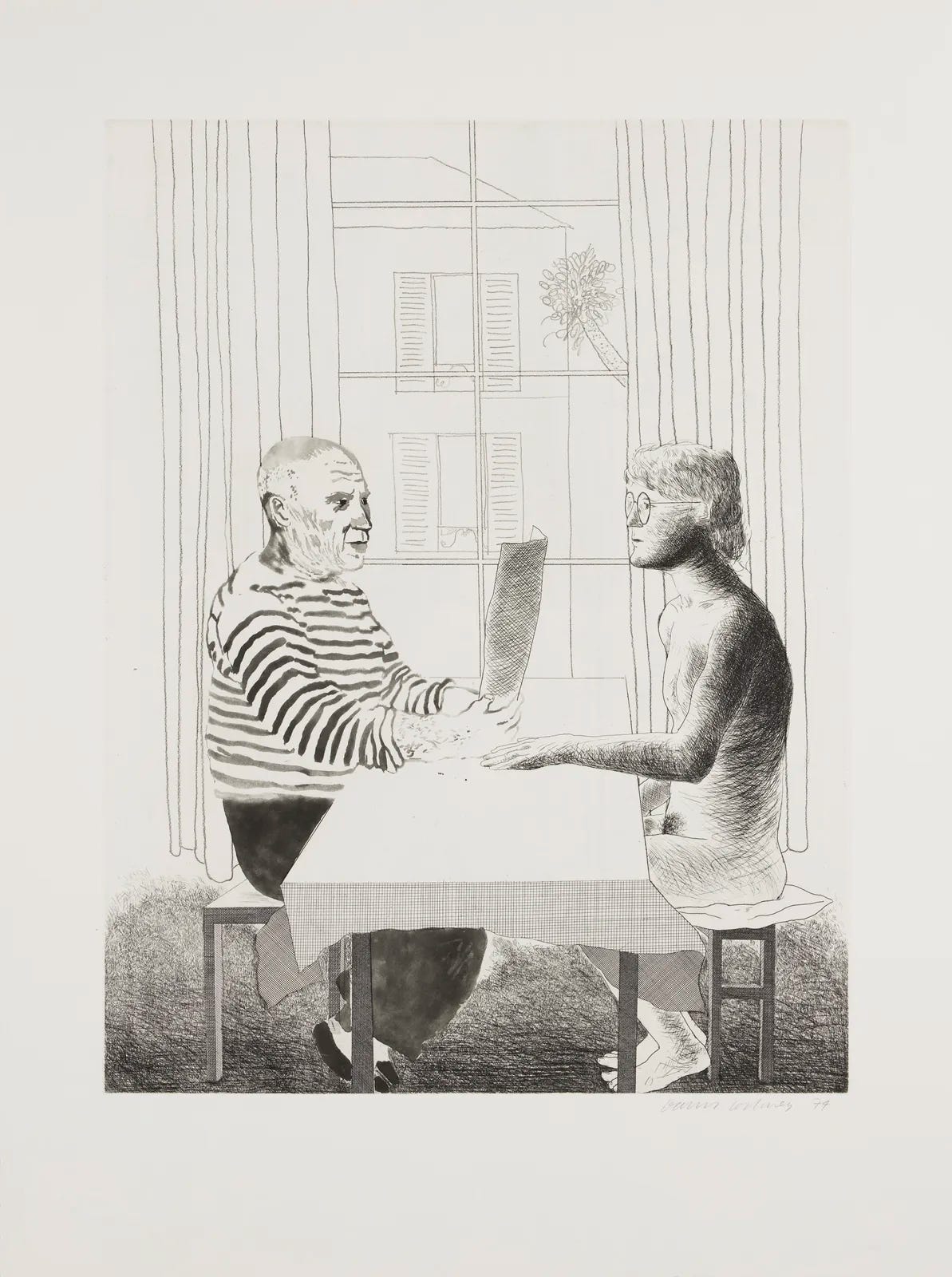
5 - He cast Picasso as the teacher and himself as the model. His admiration for Picasso was the deepest artistic attachment of his life. He said once that he found in Picasso a kindred spirit in the relentless pursuit of “transformation.” In 1973 he made an etching called Artist and Model in which Picasso is depicted seated as the artist and Hockney himself appears as the subject: a witty, generous act of homage that was also a frank admission that he, in some sense, had been made by the great Spaniard.
6 - He spent two years trying to prove that Vermeer cheated. This is an odd one. In 2001, Hockney published the book Secret Knowledge: Rediscovering the Lost Techniques of the Old Masters, arguing that painters including Vermeer, Caravaggio, Holbein, Hals, and Velázquez had used lenses and mirrors to project images onto their canvases, which they then traced. This was, and still is, a controversial point of view.
His evidence was partly visual: the transition toward photographic naturalism in Western painting around 1420 was too abrupt to be explained by new habits of seeing alone. It suggested, for Hockney, a technical breakthrough. He pointed to foreground objects in Vermeer’s paintings that appear slightly out of focus, and to the fact that Vermeer was close friends with a lens-maker. Art historians were not uniformly persuaded, and the debate has never been fully settled.
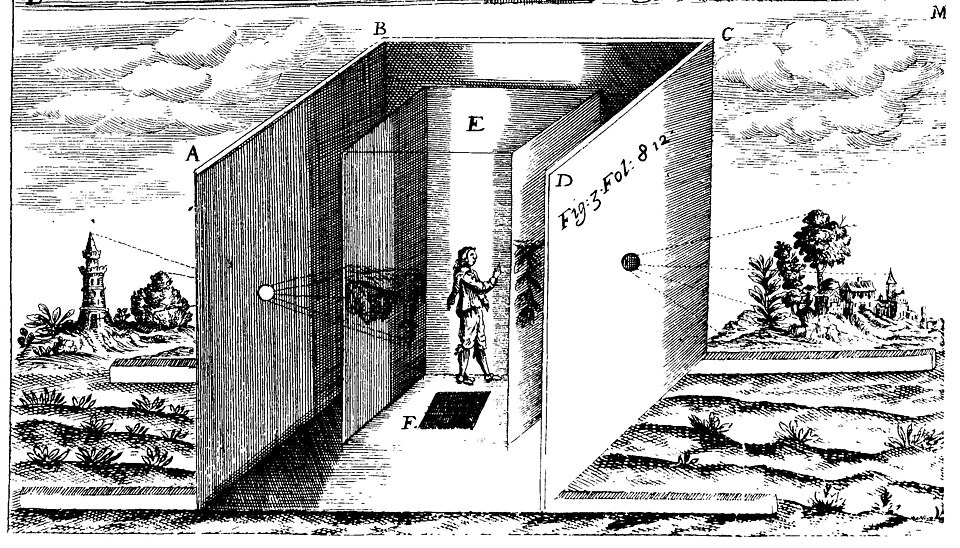
Illustration of a “portable” camera obscura studio in Kircher’s Ars Magna Lucis Et Umbrae (1645)
7 - He was painting every day until the end. In 2020, locked down in his Norman farmhouse, he began making daily iPad paintings of the seasons arriving in his garden. He sent them out to friends with a note reading “Spring cannot be cancelled.”


A few years later, in an interview, he said “I assume I’ll die soon, so I want to work every day.”
8 - Lastly, a poem, which I happened across on the same day, 11th of June 2026, that I heard about Hockney’s death. The parallels seemed too neat to ignore.
Not soon, as late as the approach of my ninetieth year,
I felt a door opening in me and I entered
the clarity of early morning.
One after another my former lives were departing,
like ships, together with their sorrow.
And the countries, cities, gardens, the bays of seas
assigned to my brush came closer,
ready now to be described better than they were before.
I was not separated from people,
grief and pity joined us.
We forget—I kept saying—that we are all children of the King.
For where we come from there is no division
into Yes and No, into is, was, and will be.
We were miserable, we used no more than a hundredth part
of the gift we received for our long journey.
Moments from yesterday and from centuries ago—
a sword blow, the painting of eyelashes before a mirror
of polished metal, a lethal musket shot, a caravel
staving its hull against a reef—they dwell in us,
waiting for a fulfillment.
I knew, always, that I would be a worker in the vineyard,
as are all men and women living at the same time,
whether they are aware of it or not.
Late Ripeness by Czeslaw Milosz, Translated By Robert Hass & Czeslaw Milosz
May he rest in peace.
All the best until next time.
There was the joy of reading his book of interviews with Martin Gafford, the astonishment of seeing his multi-camera movement through those roads in Yorkshire, the beauty of the film A DAY ON THE GRAND CANAL WITH THE EMPEROR OF CHINA, and my exposure to the work itself in Paris, Los Angeles, NY. I wish I'd had the chance to meet him. But then, I feel as if I did.
Thank you.