
The Scrapbook — No. 22
5 ideas about sitting at the edge of the ocean

I’m on holiday this week, so this is a slightly lighter version of the scrapbook, delivered to you directly from my deckchair facing the Irish ocean…
1 - Romain Rolland, winner of the 1915 Nobel Prize for Literature, once wrote to his friend Sigmund Freud about that particular sensation that comes over us when we look out to sea. Freud recalls the letter in Civilization and Its Discontents (1929):
“[The true source of religion] consists in a peculiar feeling, which [Rolland] himself is never without, which he finds confirmed by many others, and which he may suppose is present in millions of people. It is a feeling which he would like to call a sensation of ‘eternity’, a feeling as of something limitless, unbounded — as it were, ‘oceanic’. This feeling, he adds, is a purely subjective fact, not an article of faith; it brings with it no assurance of personal immortality, but it is the source of the religious energy which is seized upon by the various Churches and religious systems, directed by them into particular channels, and doubtless also exhausted by them. One may, he thinks, rightly call oneself religious on the ground of this oceanic feeling alone, even if one rejects every belief and every illusion.”
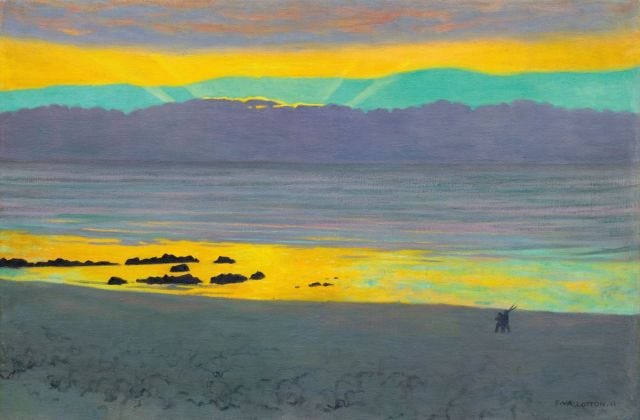
Felix Vallotton, Yellow and Green Sunset
2 - The Greeks knew a thing or two about the power of contemplating the ocean.
“But Achilles, weeping, moved off apart from his comrades, sat down on the shore of the grey, salt sea, eyes fixed on the boundless deep and appealed to his mother, arms outstretched”
Homer, Iliad, translated by Peter Green
3 -
“But great-hearted Odysseus he did not find within there, for he, as usual, was seated out on the seashore, weeping, rending his heart with tears and groans and sadness, gazing out through his tears at the unharvested sea.”
Homer, The Odyssey, translated by Peter Green
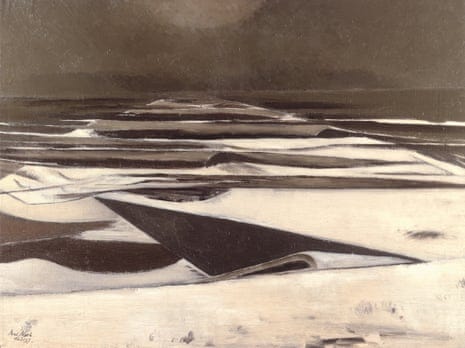
Paul Nash, Winter Sea, 1925-37
4 -
“The edge of the sea is a strange and beautiful place. All through the long history of Earth it has been an area of unrest where waves have broken heavily against the land, where the tides have pressed forward over the continents, receded, and then returned. For no two successive days is the shoreline precisely the same. Not only do the tides advance and retreat in their eternal rhythms, but the level of the sea itself is never at rest. It rises or falls as the glaciers melt or grow, as the floor of the deep ocean basins shifts under its increasing load of sediments, or as the earth’s crust along the continental margins warps up or down in adjustment to strain and tension. Today a little more land may belong to the sea, tomorrow a little less. Always the edge of the sea remains an elusive and indefinable boundary
The shore has a dual nature, changing with the swing of the tides, belonging now to the land, now to the sea. On the ebb tide it knows the harsh extremes of the land world, being exposed to heat and cold, to wind, to rain and drying sun. On the flood tide it is a water world, returning briefly to the relative stability of the open sea.”
Rachel Carson, The Edge of the Sea, 1955V
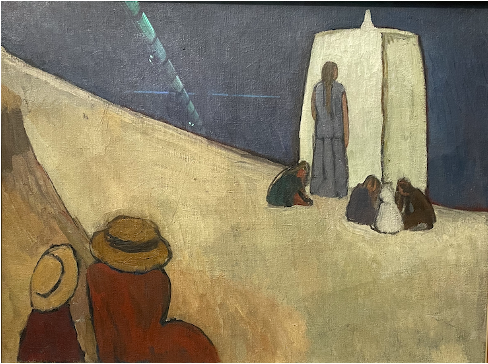
Vanessa Bell, Studland Beach, c.1912
5 -
“Nature seems to be important to people.”
Rachel and Stephen Kaplan wrote this in 1989, as the opening gambit of a twenty-year research programme.
Their Attention Restoration Theory proposed that the mind fatigues under directed effort and recovers through what they called “soft fascination,” which is their term for the effortless, involuntary attention drawn by gentle movement of things like leaves, clouds, or water. The sea is perhaps the purest instance of this.
Restoration, the Kaplans argued, requires being away, sufficient extent, compatibility with your purposes, and fascination without demand. The sea offers all of this simultaneously, and has done so, presumably, for as long as people have stood at its edge. Ask Odysseus or Achilles.
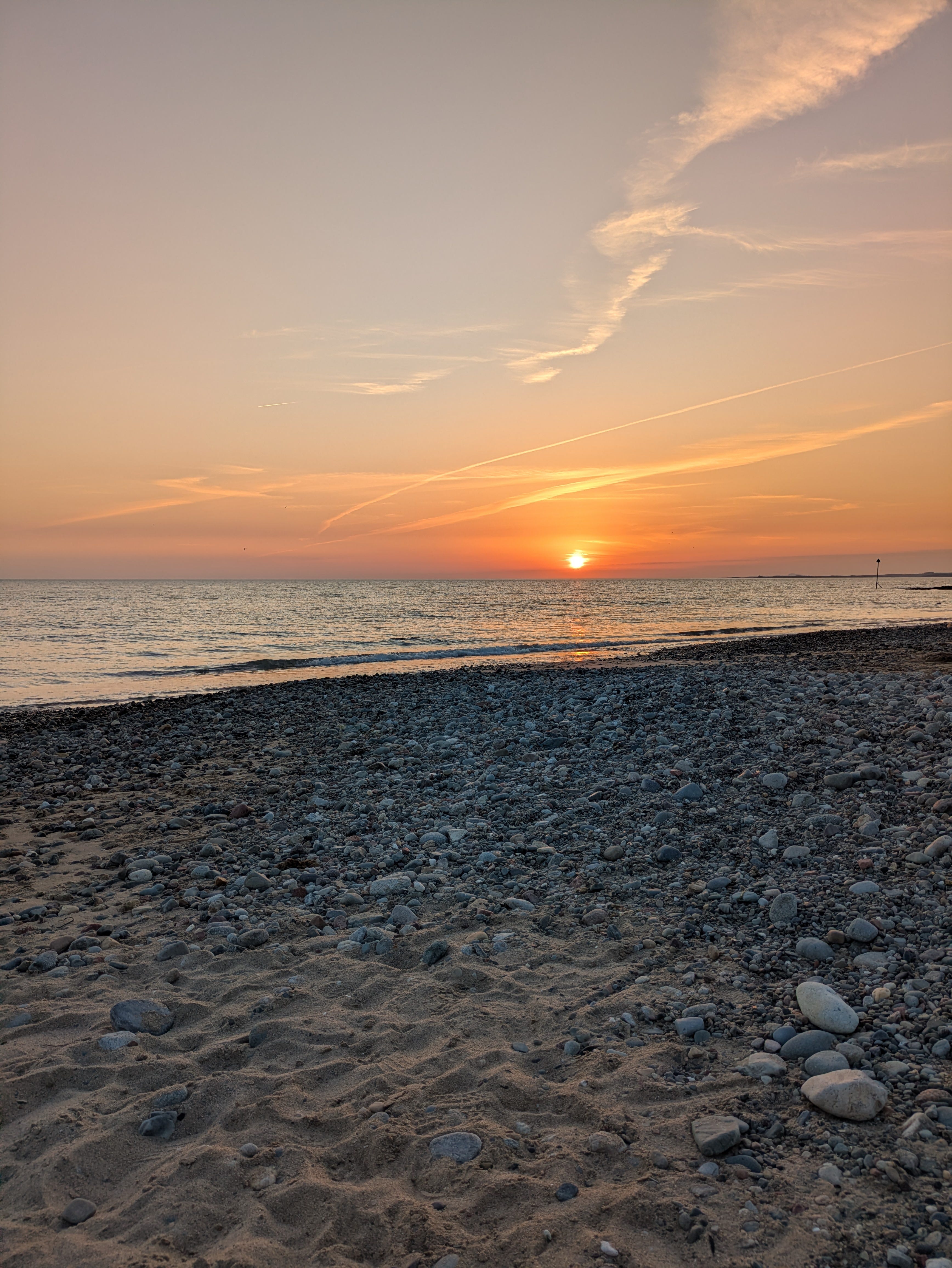
A shot from where I'm currently sat in North Wales.
In Irish Mythology, the otherworlds are often depicted as being across the sea and the magical characters we meet in those stories always come from across the waves. It shows that there has been a curiosity and beauty attached to the sea and what lies beyond for as long as humans could express it.
Loved the quotes from "The Iliad" and "The Odyssey".