
The Scrapbook — No. 21
On obedience, evil, and the strange genius of a drunk porter

10 interesting odds and ends from a week of reading…
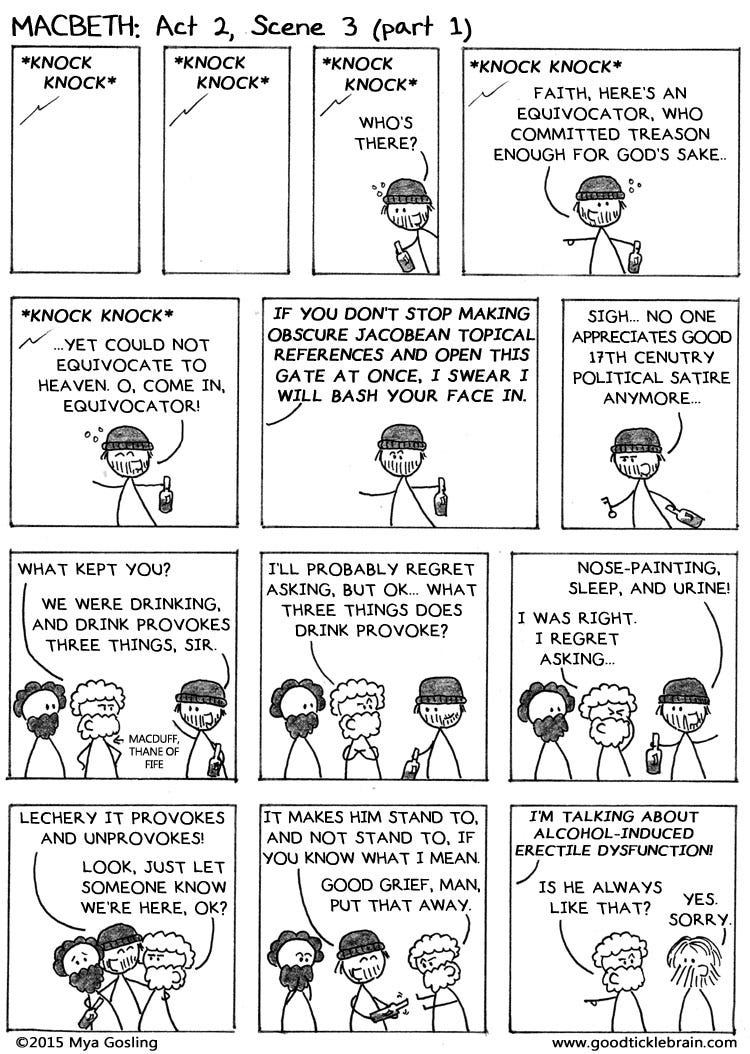
1 - What's with the knocking at the gate in Macbeth? King Duncan is dead, the guards have been framed, the audience is waiting for the discovery of the body and then... A drunk porter appears on stage, and he begins to hear a repetitive knocking. Why? Has Shakespeare lost his mind?
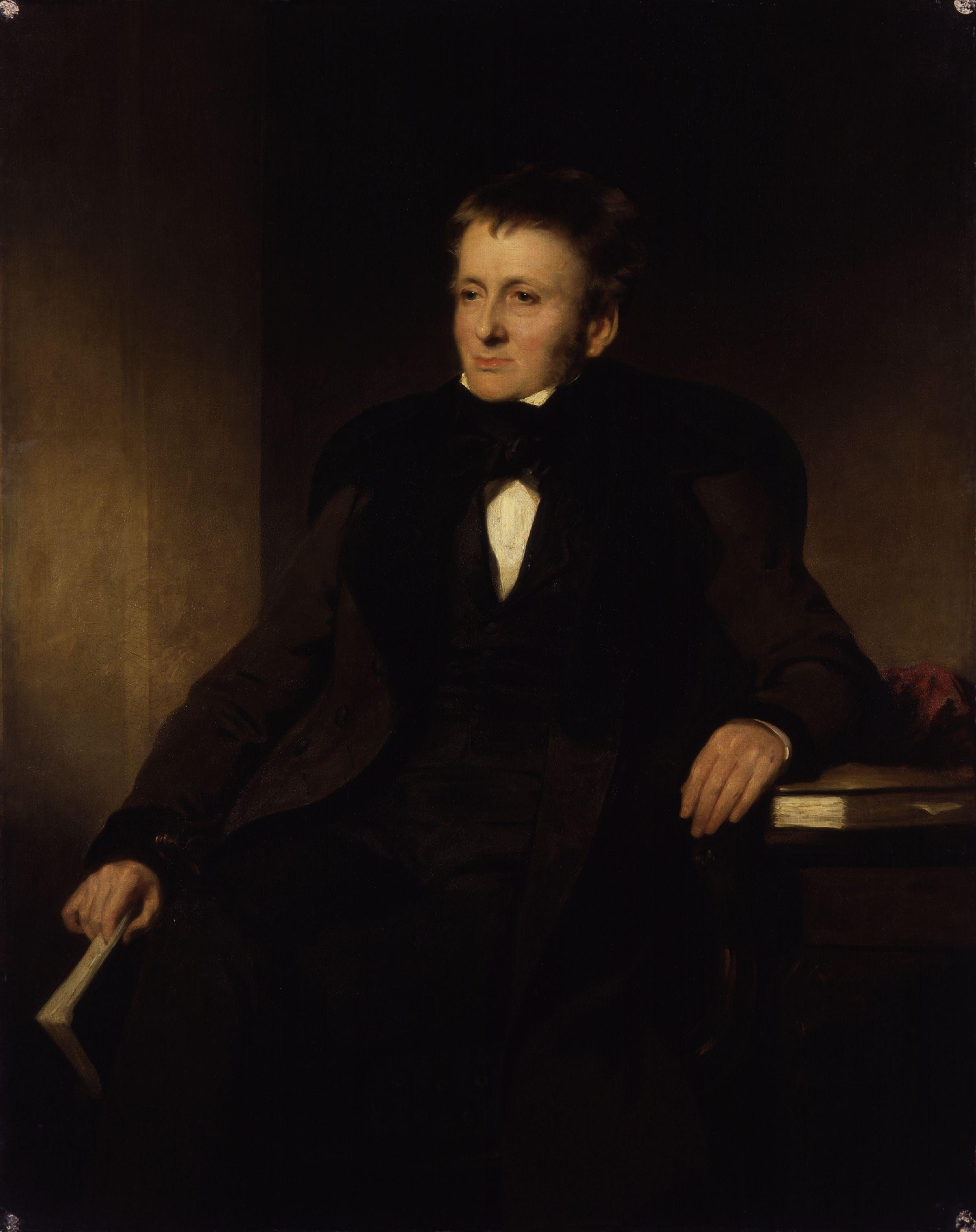
In 1823, Thomas de Quincey offered an answer to this question because he'd been plagued by it himself since his childhood. For him, Shakespeare's problem was that he had to somehow express the "retiring of the human heart" of his murderers and its replacement with a heart that was "fiendish." How? This is where de Quincey locates the significance of that knock...
"In order that a new world may step in, this world must for a time disappear. The murderers and the murder must be insulated -- cut off by an immeasurable gulf from the ordinary tide and succession of human affairs locked up and sequestered in some deep recess; we must be made sensible that the world of ordinary life is suddenly arrested -- laid asleep -- tranced -- racked into a dread armistice; time must be annihilated; relation to things without abolished; and all must pass self-withdrawn into a deep syncope and suspension of earthly passion. Hence it is, that, when the deed is done, when the work of darkness is perfect, then the world of darkness passes away like a pageantry in the clouds: the knocking at the gate is heard; and it makes known audibly that the reaction has commenced: the human has made its reflux upon the fiendish; the pulses of life are beginning to beat again; and the re-establishment of the goings-on of the world in which we live, first makes us profoundly sensible of the awful parenthesis that had suspended them."
2 - It’s a wonderful interpretation, one I always lean on in my teaching of that scene, and a brilliant illustration of Shakespeare’s art. Sometimes you just have to shake your head in baffled appreciation of true genius, which is exactly how de Quincey wraps up his essay:
“O mighty poet! Thy works are not as those of other men, simply and merely great works of art: but are also like the phenomena of nature, like the sun and the sea, the stars and the flowers; like frost and snow, rain and dew, hail-storm and thunder, which are to be studied with entire submission of our own faculties, and in the perfect faith that in them there can be no too much or too little, nothing useless or inert but that, the farther we press in our discoveries, the more we shall see proofs of design and self-supporting arrangement where the careless eye had seen nothing but accident.”
3 - The whole thing is available here and is really digestible of you need something to read with your next cup of tea.
4 - Have you ever watched footage of the infamous Milgram experiments?
In 1961, psychologist Stanley Milgram, who was fascinated by German obedience to Nazi authority in the second world war, set out to discover whether he could answer the question of how ordinary people can become capable of extraordinary acts of evil.
He recruited ordinary Americans for what they were told was a study on learning and punishment. They were instructed to administer electric shocks to a stranger every time the stranger gave a wrong answer, increasing the voltage with each mistake. The shocks were fake. The stranger was an actor. But the participants didn’t know that.
His findings were genuinely astonishing. 65% of participants administered what they believed was a potentially lethal 450-volt shock, showing how, in the right context, faced with the right white coat, the right calm instruction that “to continue is essential,” and most of us will do things we would never believe ourselves capable of.
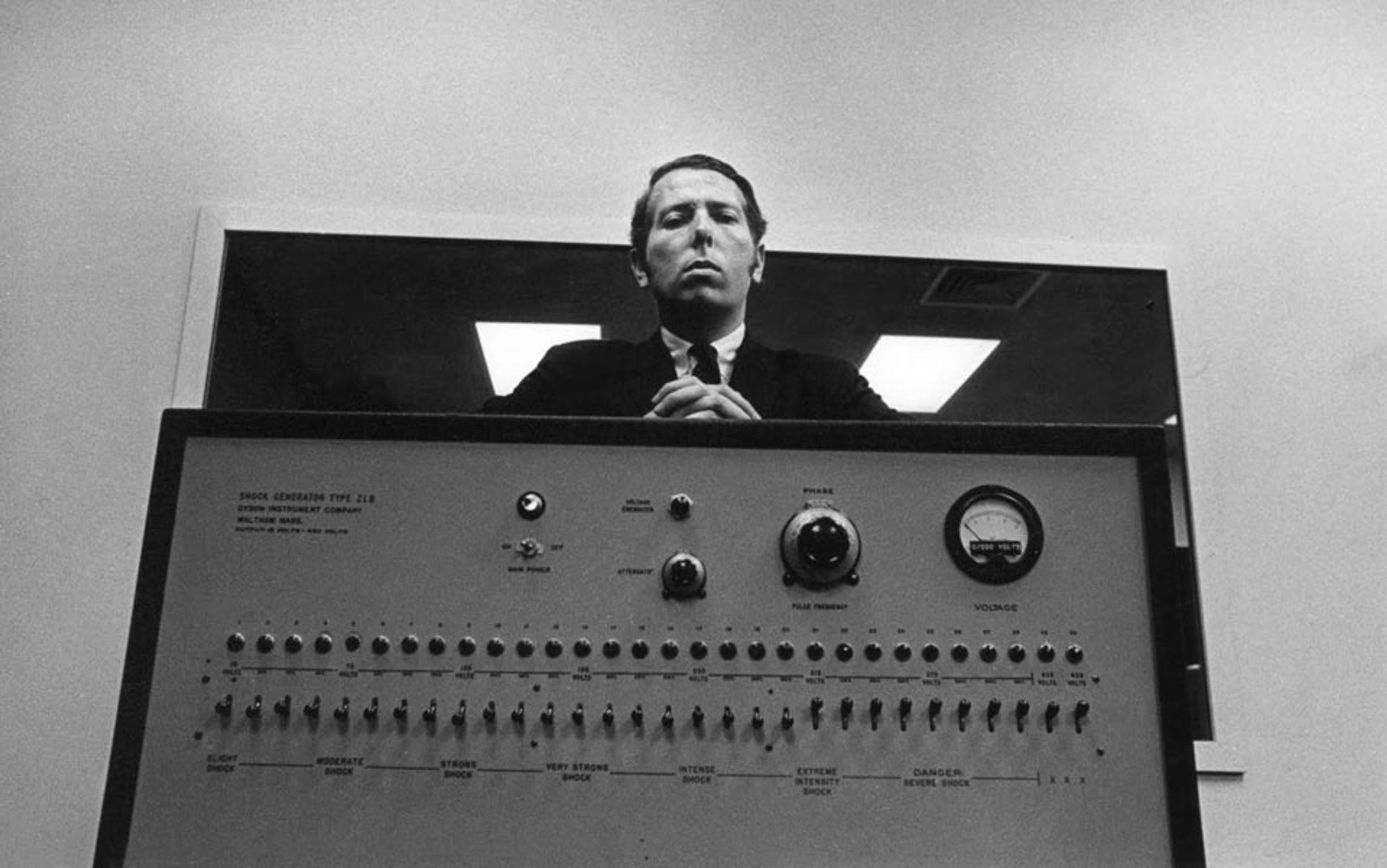
5 - It’s amazing to me that footage of this still exists on YouTube. You see the moment the participants realise what they’re doing; the hand on the forehead, the nervous laugh. And then, mostly, they continue.
6 - The connection to the work of Hannah Arendt, who attended the trial of Adolf Eichmann in Jerusalem in 1961 (the same year Milgram ran his first experiments, though neither knew the other existed), is obvious. She expected to find a monster, but in actuality found a bureaucrat, fussy, precise, and proud of his organisational efficiency. Her phrase for it, “the banality of evil,” became one of the most contested in modern thought.
“For when I speak of the banality of evil, I do so only on the strictly factual level, pointing to a phenomenon which stared one in the face at the trial. Eichmann was not Iago and not Macbeth, and nothing would have been farther from his mind than to determine with Richard III ‘to prove a villain.’ Except for an extraordinary diligence in looking out for his personal advancement, he had no motives at all… He merely, to put the matter colloquially, never realized what he was doing… It was sheer thoughtlessness—something by no means identical with stupidity—that predisposed him to become one of the greatest criminals of that period. And if this is ‘banal’ and even funny, if with the best will in the world one cannot extract any diabolical or demonic profundity from Eichmann, this is still far from calling it commonplace… That such remoteness from reality and such thoughtlessness can wreak more havoc than all the evil instincts taken together which, perhaps, are inherent in man—that was, in fact, the lesson one could learn in Jerusalem.”
7 - All of this shines a light on our own idea of our own decency. We’re good people, we tell ourselves. We’d behave differently to these others if the universe presented a genuine test of our morals. But what if our morality had less to do with our personality, our upbringing, or influences, our faith, our way of thinking through ethical problems etc. and more to do with plain circumstance?
In 1973, psychologists Darley and Batson ran an experiment at Princeton Theological Seminary. Students were asked to prepare a short talk, then walk across campus to deliver it. Some were told they were running late, some were told they had plenty of time. Along the route, a man was slumped in a doorway, visibly in distress. The single biggest predictor of whether someone stopped to help was not their personality, not their faith, not even the subject of the talk they were about to give (several were preparing to speak on the parable of the Good Samaritan). It was whether they were in a hurry. Situation, again, swallowing character whole.
8 - Switching gears entirely now, to the work of an artist I’ve been wondering at this past week since I featured her in the main article about William James and consciousness after death.
Emma Kunz was a Swiss healer and researcher who, from the 1930s onwards, produced large-scale geometric drawings on graph paper using a pendulum. She never called them art, thinking of her work as something more like research. Her sessions with pencil and pendulum, which often lasted through the night, guided her toward answers to questions she was asking about energy, proportion, and the nature of the human body.

9 - Did I mention that they’re beautiful?


10 - I was caught in a downpour on Sunday evening, which had the pleasant effect of bringing to mind these words from Anne Carson, which is where we'll leave things this week:
"Sunday evening, evening gray. All day the storm did not quite storm. Clouds closed in, sulked, spat. We put off swimming. Took in the chairs. Finally (about seven) a rumbling high up. A wind went round the trees tossing each once and releasing arbitrary rivulets of cool air downward, this wind which came apart, the parts swaying out, descending, bumping around the yard awhile not quite on the count then a single chord ran drenched across the roof, the porch and stopped. We all breathed. Maybe that’s it, maybe it’s over, the weatherman is often wrong these days, we can still go swimming (roll call? glimpse of sun?) when all at once the sluices opened, broke a knot and smashed the sky to bits, which fell and keep falling even now as dark comes on and fabled night is managing its manes and the birds, I can hear from their little racket, the birds are burning up and down like holy fools somewhere inside it—far in where they keep the victim, smeared, stinking, hence the pageantry, hence the pitchy cries, don’t keep saying you don’t hear it too.”
That's everything for this week. All the best until next time!
Some interesting threads running through this post. I love the porter scene in Macbeth. “I pray you, remember the porter.” And he does stay with me. I saw a production once where the porter remained on stage after his scene and marked the deaths piling up in chalk on the wall. Like the weird sisters, he’s one of the few observers outside of the murderous drama. As interesting as he is, I suspect Will was looking for some light comic relief in a brilliant but otherwise dark play, and this was his only chance.
There’s always some low comedy for the groundlings.