
The Scrapbook — No. 11
From the reading room: w/c 9th March 2026

The Scrapbook is a weekly commonplace for members of The Humanities Library, collecting brief notes, images, fragments and curiosities from a week of reading.
Except this week I'm sending it to everyone, just to give you a taste.
1 - We start with a story. Last week we wrote about René Descartes and his conviction that the mind and body are entirely separate substances — a philosophical position so influential it still shapes how we talk about consciousness today. It turns out the universe has a sense of humour about these things.
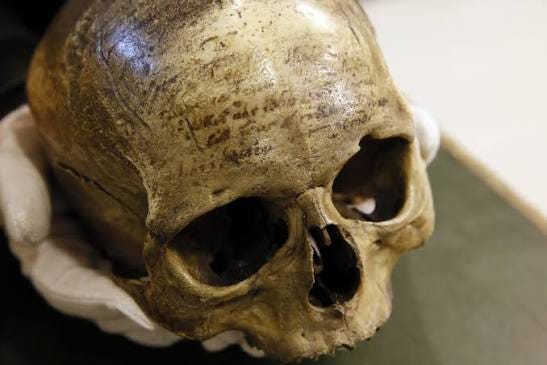
Descartes died in Stockholm in 1650. When Louis XIV ordered his remains returned to Paris sixteen years later, the coffin arrived with two notable absences: his right index finger (pocketed by the French ambassador as a personal relic) and, more troublingly, his skull. What followed is one of the stranger episodes in the history of philosophy: a seventeenth-century Swede named Planström, apparently in debt and in possession of a corpse, is thought to have employed a technique known as skull blasting — filling the cranium with dried peas, adding water, and waiting for the expanding starches to crack the skull neatly along its sutures, yielding six to eight marketable pieces. A 2014 study confirmed that dried chickpeas are the fastest method, edging out mung beans. Science marches on.
France believes they have the genuine article, now held at the Musée de l'Homme in Paris. Sweden disagrees, pointing to a fragment in Lund inscribed, in Swedish, *the skull of Descartes, 1691, number 6.* DNA testing has been ruled out; there are no living descendants and the remaining remains are in poor condition. The matter is, philosophically speaking, unresolved.
The man who split mind from body was himself split for parts. You couldn't write it.
2 - There's a second curious little story that circulates around Descartes, though historians are sceptical of it.
Descartes had a real daughter, Francine, born to a Dutch servant he referred to publicly as his niece. She died of scarlet fever at five. The legend (almost certainly invented) holds that grief drove him to build a mechanical replica, which he kept in a casket beside his bed and took everywhere. When Queen Christina summoned him to Stockholm, the casket came too. During the voyage, the crew grew uneasy. Someone broke in. The automaton sat up. They hauled her to the deck and threw her into the sea.
3 - Another curiosity cut from the main newsletter owing to my deep respect for the time of you good people. Here's the story:
During the Second World War, Emmanuel Levinas spent years in a German POW camp while his family in Lithuania were murdered. He tells of how a stray dog used to appear at the camp and greet the Jewish prisoners with tail-wagging excitement, wholly indiscriminate, apparently unbothered by their status as prisoners in Nazi society. Levinas named him Bobby, and called him "the last Kantian in Nazi Germany,” the only being in that environment who still treated the prisoners as ends in themselves rather than a category.
4 - I've heard of the Rosetta stone; you've heard of the Rosetta stone. I know that it helped us to discover the mysteries of Egyptian hieroglyphics; you know that too. What I didn't know, until my YouTube rabbit hole took me to this video this week, created by Egyptologist Franziska Naether, was how. What does it say? What were the clues? What was the process? All questions answered here:
5 — Those vast, luminous Rothko rectangles are the result of an almost obsessive process: unprimed canvas, hand-mixed pigments, layer upon layer of thin washes, each one left to dry before the next was applied. A fascinating deep-dive via the Harvard Art Museums:
https://harvardartmuseums.org/tour/39/slide/513

6 - Let's not share this too widely, but Álvaro Mutis’s The Adventures of Maqroll, a series of novellas following a wandering, world-weary Colombian sailor-philosopher called the Gaviero, or “the lookout,” is an absolute gem.
A few passages by way of introduction:
“Life attacks us like a blind beast. It swallows up time, the years of our life, it passes like a typhoon and leaves nothing behind. Not even memory, because memory is made of the same swift, ungraspable substance out of which illusions emerge and then disappear.”
“There at the top of the highest mast, in the crow's nest where the lookout questions the horizon, all mystery vanishes in the flight of curlews and gulls and the crack of the sail in the wind, and nothing is left standing in us. Believe me!”
“I wouldn’t care if we turned back right now. I won’t, through pure inertia. As if it were just a matter of making this trip, seeing the jungle and sharing the experience with people I’ve met here, going back with new images, voices, lives, smells, deliriums, to add to all the other phantoms that walk with me, with no other purpose than to unravel the monotonous, tangled skein of time.”
7 - This is a horse called Clever Hans.
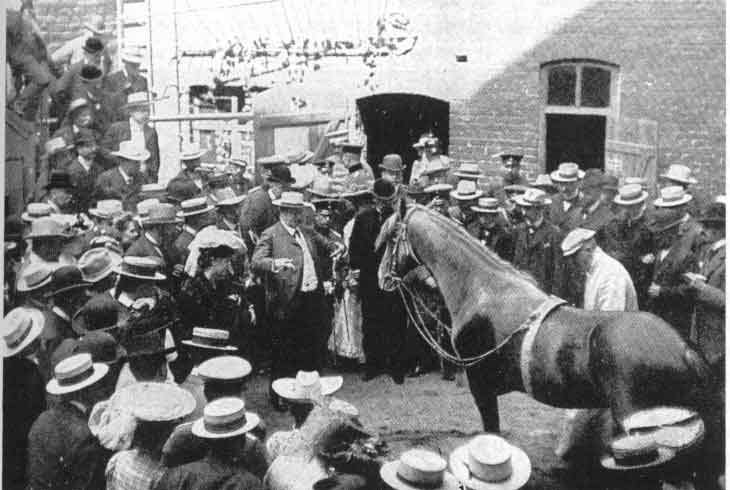
In early twentieth-century Berlin, he became a sensation for his apparent ability to do arithmetic, spelling, and calendar calculations by tapping his hoof. A scientific commission investigated and declared him genuine. It took a psychologist named Oskar Pfungst to notice that Hans could only answer correctly when the questioner already knew the answer. He was reading microscopic, involuntary shifts in their posture as they waited for the right number of taps. Not doing maths, then. But still a rather impressive ability to read people.
Psychology still uses the “Clever Hans effect” to describe experiments contaminated by unintentional cues from researchers to subjects.
8 - David Lynch on that wonderful final scene in The Straight Story, writing in Room to Dream with Kristine McKenna:
“My favorite scene in the film is the ending. What Richard and Harry Dean did together is just incredible. Jack built Lyle's house, which was a beautiful house, and it was up high and was surrounded by mountains and there was sort of a dip in the mountains where it sat. So Richard is going down this incline toward the house with the heavy weight of the trailer behind him, and he turns into Lyle's and the thing stops. Richard gets off and walks partway to the house and he calls out to Lyle. The light was just beautiful and the sun was right on him and he calls out to Lyle and the second after he did that the sun goes behind the mountain. If we'd been seconds later we would've missed that completely. We were so lucky to get that. Then, when Richard spoke to Lyle he had this little choke in his throat, and that little choke of the heart is incredible. Harry Dean and Richard Farnsworth? The word "natural" is them. Harry is as pure as can be and Richard's that way, too, and you can feel that in that scene.”
9 - A good excuse to watch it back, I reckon. Here's the scene, complete with that heartbreaking throat croak:
All the best until next time!
I love the fragment form of these – very interesting to read!
Thanks for the tip, it is a wonderful movie to relax with