
Perspectives | On Spring (re-post)
By Shakespeare, Tennyson, Rilke and Others

Owing to family commitments, illnesses, and a general lack of thinking and reading time this week, I'm sending out a post that first saw the light of day around a year ago.
This is a collection of voices on the topic of spring. My own personal definition of the first day of spring is when the blossom tree on my street starts to bloom. We're not quite there yet, but this still feels seasonally appropriate. There's daffodils showing their faces, after all.
In an act of immeasurable decency, I've started the collection with something that wasn't included first time around. As always, I'd love to hear what I've missed in the comments. Enjoy, and normal service should be resumed next week.
Readers drawn to this theme may also enjoy earlier collections on:
gathered in the archive for library members.
On longer evenings, / Light, chill and yellow, / Bathes the serene / Foreheads of houses.
A thrush sings, / Laurel-surrounded In the deep bare garden, / Its fresh-peeled voice / Astonishing the brickwork.
It will be spring soon, / It will be spring soon / And I, whose childhood Is a forgotten boredom, / Feel like a child / Who comes on a scene / Of adult reconciling, / And can understand nothing / But the unusual laughter, / And starts to be happy.
Philip Larkin, Coming
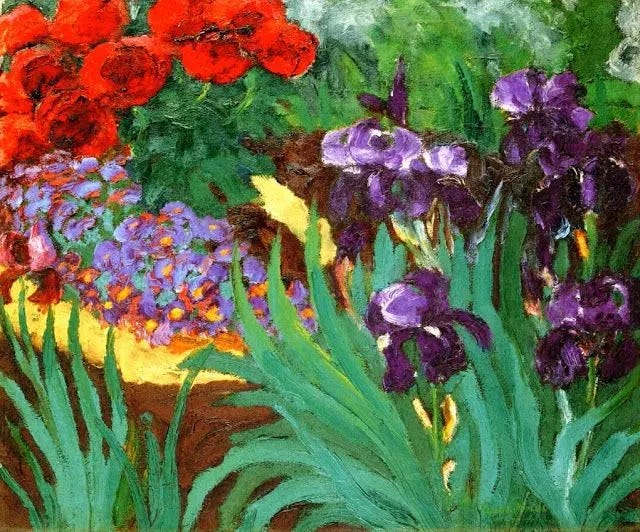
Flower Garden, 1922, Emil Nolde
‘As simple as that -
Spring has finally arrived
With a pale blue sky’
Kobayashi Issa, 1763-1827
‘A Sensitive Plant in a garden grew, / And the young winds fed it with silver dew, / And it opened its fan-like leaves to the light. / And closed them beneath the kisses of Night.
And the Spring arose on the garden fair, / Like the Spirit of Love felt everywhere; / And each flower and herb on Earth’s dark breast / Rose from the dreams of its wintry rest.’
The Sensitive Plant, Percy Byshe Shelley, 1822
‘Levin put on his big boots, and, for the first time, a cloth jacket, instead of his fur cloak, and went out to look after his farm, stepping over streams of water that flashed in the sunshine and dazzled his eyes, and treading one minute on ice and the next into sticky mud.
Spring is the time of plans and projects. And, as he came out into the farmyard, Levin, like a tree in spring that knows not what form will be taken by the young shoots and twigs imprisoned in its swelling buds, hardly knew what undertakings he was going to begin upon now in the farm work that was so dear to him. But he felt that he was full of the most splendid plans and projects.’
Leo Tolstoy, Anna Karenina, 1878
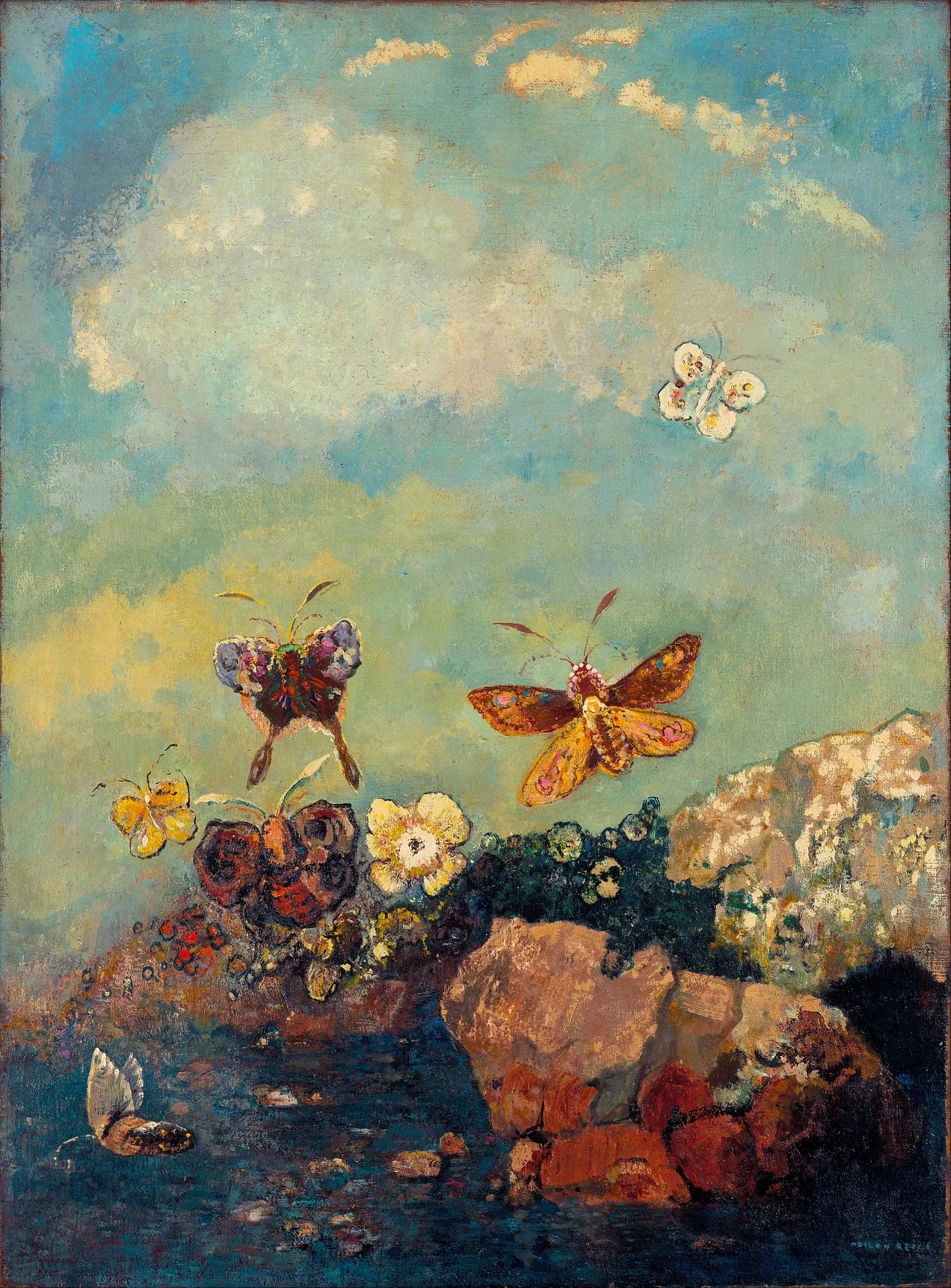
Butterflies, 1910, Odilon Redon
‘“You run off and explore, my pretty one!” he said. “I’ll deal with the boat.” When she was gone he thought to himself, “It’s the way she parts her hair and pulls it back and twists it, that I like so well. Who would have guessed that I’d find her like this the first minute I got to my native land? He frowned a little and then closed his eyes. Though it was warm enough to be May rather than March, it was too early for that confusing murmur of insects which is the usual background for a hot afternoon. When the rustling of her steps died away an incredible silence descended on the place. The newborn reeds were too young to play with the flowing river. The noon had become afternoon. The larks were silent. The fish had ceased to rise. There were no swallows yet and the few spring flies that hovered over that weedy ditch were safe from attack whether from the firmament above or the firmament below. The only sound that reached his ears was the sound of a faint trickle of water which came from some infinitesimal ledge in the bank above his head and fell down drop by drop into the ditch. Not a breath of wind stirred. Not a leaf-bud quivered. Not a grass-blade swayed. There was only That elfin waterfall and, except for that, the very earth herself seemed to have fallen asleep. “This is Norfolk,” he said to himself, and in that intense, indrawn silence some old atavistic affiliation with fen-ditches and fen-water and fen-peat tugged at his soul and pulled it earthward.’
John Cowper Powys, a Glastonbury Romance, 1932
‘A thousand welcomes to spring, though she can-not bring back, with all her flowers, the flower of our youth; though she cannot, with all her poe-try, bring back the poetry of early love though she cannot repaint the rose on cheeks that are pil-lowed beneath the yew; nor enable us to offer the first-gathered violets to the dear souls who are in heaven; yet she brings joy to the earth still.’
William Howitt, On the Month of April, 1871
‘Spring has come back again. The Earth is / like a child that’s got poems by heart; / so many poems, so many verses, / patient toil winning her prizes at last.
Strict, the old teacher. We loved the whiteness in the old gentleman’s beard, its bright snow. / Now when we ask what the green, what the blue is, / Earth knows the answer, has learned it. She knows.
Earth, you’re on holiday, lucky one: play now! / Play with us children! We’ll try to catch you. / Glad, joyous Earth! The gladdest must win.
Every lesson the old teacher taught her, / all that is printed in roots and laborious / stems: now she sings it! Listen, Earth sings!
Rainer Maria Rilke, Sonnets to Orpheus, 1922
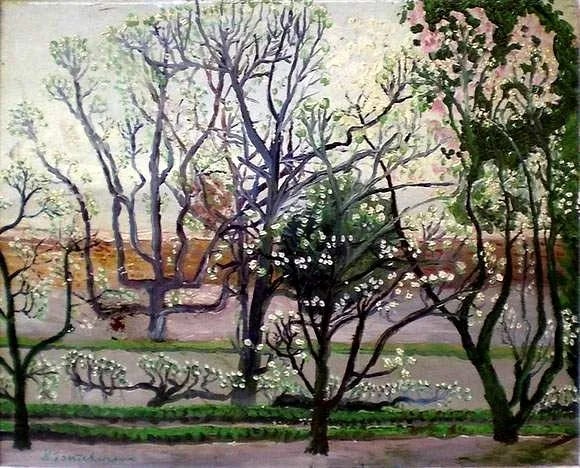
Blooming Magnolias - The garden in spring, c1908, Natalia Goncharova
‘Connie went to the wood directly after lunch. It was really a lovely day, the first dandelions making suns, the first daisies so white. The hazel thicket was a lace-work, of half-open leaves, and the last dusty perpendicular of the catkins. Yellow celandines now were in crowds, flat open, pressed back in urgency, and the yellow glitter of themselves. It was the yellow, the powerful yellow of early summer. And primroses were broad, and full of pale abandon, thick-clustered primroses no longer shy. The lush, dark green of hyacinths was a sea, with buds rising like pale corn, while in the riding the forget-me-nots were fluffing up, and columbines were unfolding their ink-purple ruches, and there were bits of blue bird’s eggshell under a bush. Everywhere the bud-knots and the leap of life!’
D.H. Lawrence, Lady Chatterley’s Lover, 1928
‘We lay on the grass / covered dried blood with our / bodies / green blades swayed between / our teeth.’
Etel Adnan, from The Spring Flowers Own: “The morning after / my death”, 1990
‘Like souls that balance joy and pain, / With tears and smiles from heaven again / The maiden Spring upon the plain / Came in a sun-lit fall of rain. / In crystal vapour everywhere / Blue isles of heaven laugh’d between, / And far, in forest-deeps unseen, / The topmost elm-tree gather’d green / From draughts of balmy air.
Sometimes the linnet piped his song: / Sometimes the throstle whistled strong: / Sometimes the sparhawk, wheel’d along, / Hush’d all the groves from fear of wrong: / By grassy capes with fuller sound / In curves the yellowing river ran, / And drooping chestnut-buds began / To spread into the perfect fan, / Above the teeming ground.’
Alfred Lord Tennyson, Sir Launcelot and Queen Guinevere, 1843
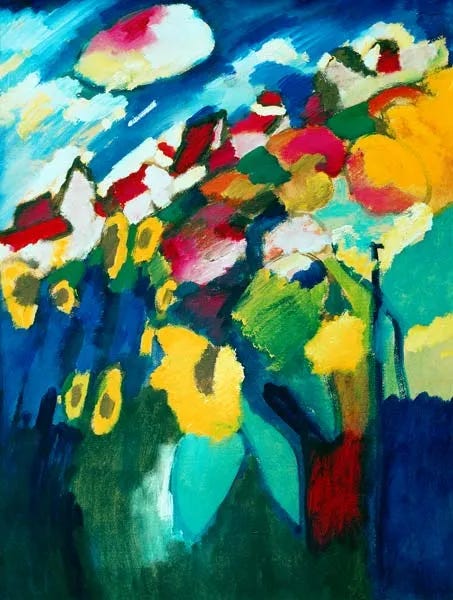
Murnau The Garden II, 1910, Wassily Kandinsky
‘Spring, the sweet spring, is the year’s pleasant king, / Then blooms each thing, then maids dance in a ring, / Cold doth not sting, the pretty birds do sing: / Cuckoo, jug-jug, pu-we, to-witta-woo!’
Thomas Nashe, Spring, the sweet spring, 1600
‘It is not the variegated colors, the cheerful sounds, and the warm breezes, which enliven us so much in spring; it is the quiet prophetic spirit of endless hopes, a presentiment of many joyful days, of the happy existence of such manifold natures, the anticipation of higher everlasting blossoms and fruits, and the secret sympathy with the world that is developing itself’
Martin Opitz
‘It’s hard to die in the spring, you know’
Jacques Brel, lyrics from Le Moribund, 1961
‘”Springtime’s comin’,” he said. “Cannot tha’ smell it?”
Mary sniffed and thought she could.
“I smell something nice and fresh and damp,” she said.
“That’s th’ good rich earth,” he answered, digging away. “It’s in a good humor makin’ ready to grow things. It’s glad when plantin’ time comes. It’s dull in th’ winter when it’s got nowt to do. In th’ flower gardens out there things will be stirrin’ down below in th’ dark. Th’ sun’s warmin’ ‘em. You’ll see bits o’ green spikes stickin’ out o’ th’ black earth after a bit.”
“What will they be?” asked Mary.
“Crocuses an’ snowdrops an’ daffydowndillys. Has tha’ never seen them?”
“No. Everything is hot, and wet, and green after the rains in India,” said Mary. “And I think things grow up in a night.”
“These won’t grow up in a night,” said Weatherstaff. “Tha’ll have to wait for ‘em. They’ll poke up a bit higher here, an’ push out a spike more there, an’ uncurl a leaf this day an’ another that. You watch ‘em.”
“I am going to,” answered Mary.’
Frances Hodgson Burnett, The Secret Garden, 1911
‘A Light exists in Spring / Not present on the Year / At any other period — / When March is scarcely here
A Color stands abroad / On Solitary Fields / That Science cannot overtake / But Human Nature feels.
It waits upon the Lawn, / It shows the furthest Tree / Upon the furthest Slope you know / It almost speaks to you.
Then as Horizons step / Or Noons report away / Without the Formula of sound / It passes and we stay —
A quality of loss / Affecting our Content / As Trade had suddenly encroached / Upon a Sacrament.’
Emily Dickinson, A Light exists in Spring, c.1875
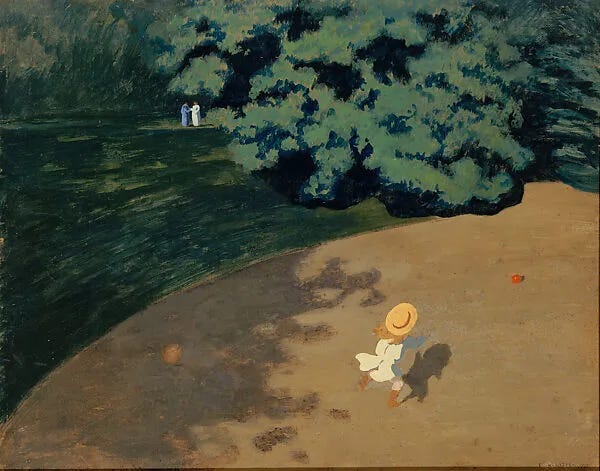
The Ball, 1891, Félix Vallotton
‘For the same reasons that the hedonic value of any emotion-inducing stimulus decreases with continued exposure (Cabanac, 1971), it would be maladaptive for pleasant weather to have the same hedonic effect irrespective of prior exposure. Thus, we [predict] that warm and sunny days in the spring (when people have been deprived of such weather) boost mood and alter cognition more than warm and sunny days later in the year, when pleasant weather is less of a novelty.’
Keller et al. (2005) A Warm Heart and a Clear Head: The Contingent Effects of Weather on Mood and Cognition
‘There is no time like Spring, / Like Spring that passes by; / There is no life like Spring-life born to die, / Piercing the sod, / Clothing the uncouth clod, / Hatched in the nest, / Fledged on the windy bough, / Strong on the wing: / There is no time like Spring that passes by, / Now newly born, and now / Hastening to die.’
Christina Rossetti, Spring, 1859
‘April is the cruellest month, breeding / Lilacs out of the dead land, mixing / Memory and desire, stirring / Dull roots with spring rain. /
Winter kept us warm, covering / Earth in forgetful snow, feeding / A little life with dried tubers. /
Summer surprised us, coming over the Starnbergersee / With a shower of rain; we stopped in the colonnade, / And went on in sunlight, into the Hofgarten, / And drank coffee, and talked for an hour.’
T. S. Eliot, The Waste Land, 1922
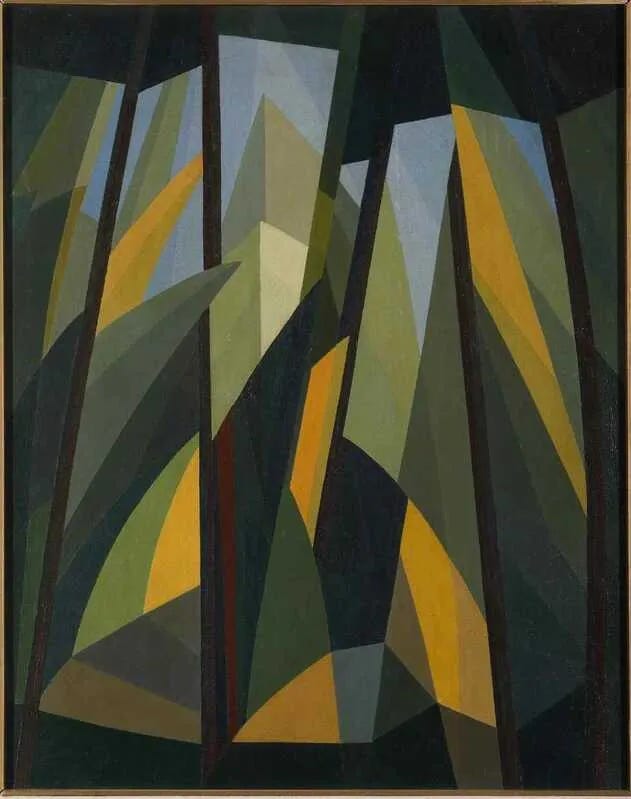
Vallombrosa, 1916, Emilio Pettoruti
‘The trees are afraid to put forth buds, / And there is timidity in the grass; / The plots lie gray where gouged by spuds, / And whether next week will pass / Free of sly sour winds is the fret of each bush / Of barberry waiting to bloom.
Yet the snowdrop’s face betrays no gloom, / And the primrose pants in its heedless push, / Though the myrtle asks if it’s worth the fight / This year with frost and rime / To venture one more time / On delicate leaves and buttons of white / From the selfsame bough as at last year’s prime, / And never to ruminate on or remember / What happened to it in mid-December.’
Thomas Hardy, A Backwards Spring, 1917
‘From you have I been absent in the spring, / When proud-pied April, dressed in all his trim, / Hath put a spirit of youth in everything, / That heavy Saturn laughed and leaped with him.
Yet nor the lays of birds, nor the sweet smell / Of different flowers in odour and in hue, / Could make me any summer’s story tell, / Or from their proud lap pluck them where they grew:
Nor did I wonder at the lily’s white, / Nor praise the deep vermilion in the rose; / They were but sweet, but figures of delight / Drawn after you, – you pattern of all those.
Yet seem’d it winter still, and, you away, / As with your shadow I with these did play.’
William Shakespeare, Sonnet 98, 1609
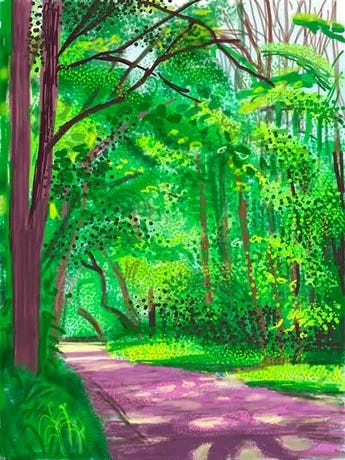
Arrival of Spring in Woldgate, 2011, David Hockney
‘It was one of those March days when the sun shines hot and the wind blows cold: when it is summer in the light, and winter in the shade. We had our pea-coats with us, and I took a bag. Of all my worldly possessions I took no more than the few necessaries that filled the bag. Where I might go, what I might do, or when I might return, were questions utterly unknown to me’
Charles Dickens, Great Expectations, 1861
‘Years of gladness, / Days of joy, / Like the torrents of spring / They hurried away.”
From an Old Ballad
"O sweet spontaneous
earth how often have
the
doting
fingers of
prurient philosophers pinched
and
poked
thee
,has the naughty thumb
of science prodded
thy
beauty how
often have religions taken
thee upon their scraggy knees
squeezing and
buffeting thee that thou mightest conceive
gods
(but
true
to the incomparable
couch of death thy
rhythmic
lover
thou answerest
them only with
spring)
O SWEET SPONTANEOUS]”
e.e. cummings, O Sweet Spontaneous, 1923
‘And I will walk and talk in gardens all wet with rain / And I will never ever grow so old again’
Van Morrison, Lyrics from Sweet Thing, 1968
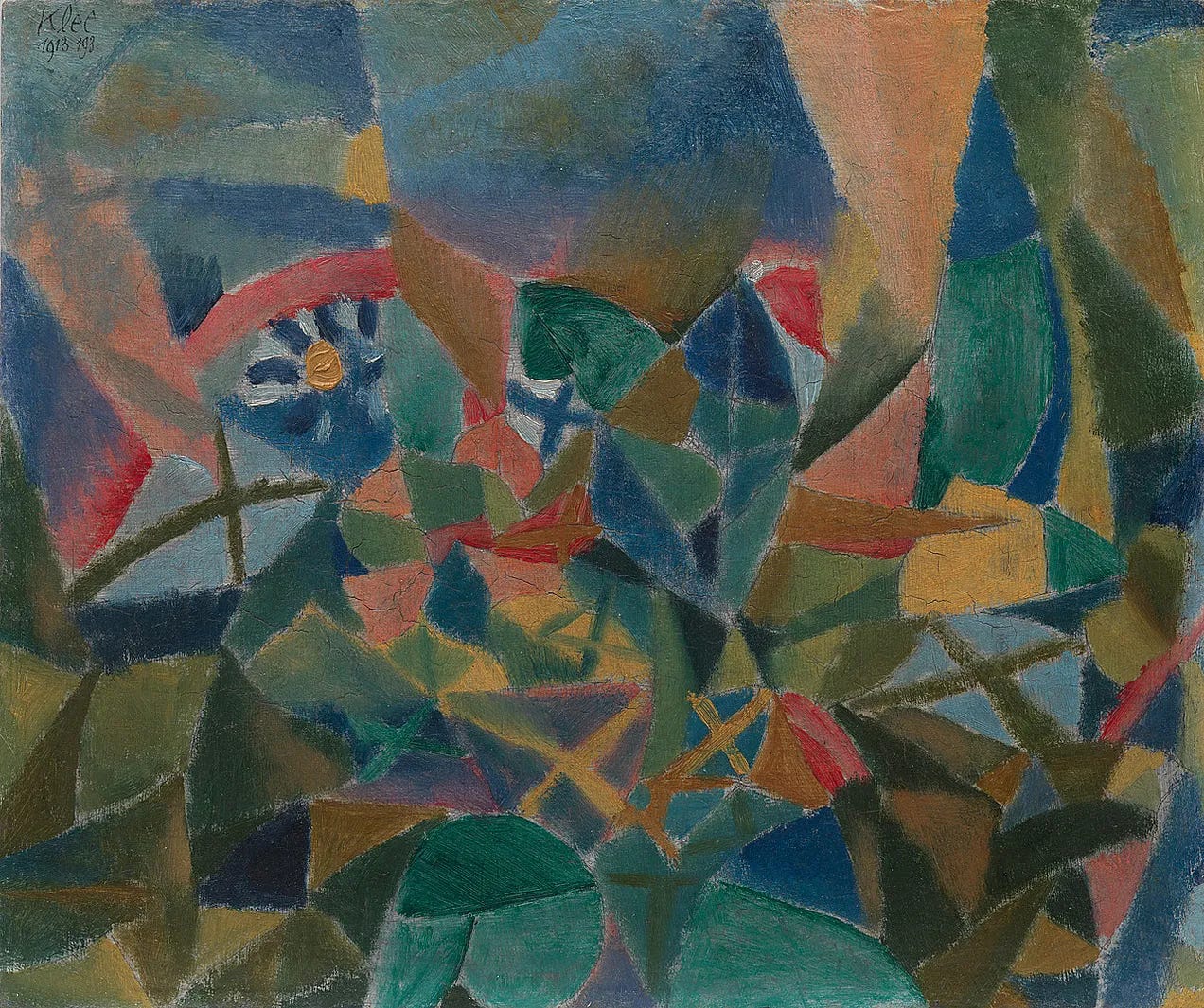
Flower Bed, 1913, Paul Klee
In the Swiss Alps: Yesterday, it snowed, heavy and wet and wondrously white
and then it froze overnight
within a stilled fog
until a pale arc of yellow light
and five querulous tiny birds with yellow throats
Sparring over seeds
reminded us of Spring this morning
and winter, the joker, laughed
and retreated up the mountainside.
Thank you for being one of the Reminders. What a lovely collection.
Keep well!