
Archive Issue
Derek Parfit, Boethius, Kierkegaard and Fernando Pessoa

It's been a difficult week for a few reasons so I'm afraid I'm turning, with apologies, to the archives. Normal service will resume next week with the full issue that had been due today.
What you'll get:
From issue #24: Who Am I? And does it Matter? Derek Parfit on Personal Identity #philosophy
From issue #21: Boethius on the Three Types of Music #music #philosophy
From issue#6: Kierkegaard on estrangement #philosophy
From issue #12: Bergamo doors of the dead #anthropology
From issue #33: Dreaming with Fernando Pessoa #literature
Who Am I? And does it Matter? Derek Parfit on Personal Identity #philosophy
Source: Chapters 10-13 of Reasons and Persons by Derek Parfit, 1984
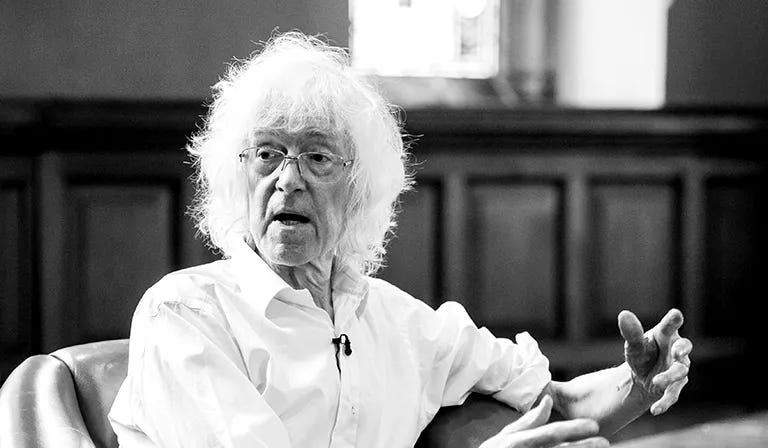
At a glance: Derek Parfit radically challenges the idea of a fixed self, arguing that by letting go of rigid notions of personal identity, we can live more ethically and compassionately.
Let us begin this week with the mythical ship of the ancient greek hero Theseus.
When he wasn’t slaying Minotaurs, legend has it that Theseus’s trusty vessel underwent a fair bit of routine maintenance. Over time, as parts of the ship wore out, they were replaced with new ones, plank by water-damaged plank, until eventually there wasn’t an original piece left in the entire vessel.
He was nothing if not meticulous. You can imagine him waxing the steering wheel, arguing with dock workers over the price of a new rudder, tightening loose rigging whilst talking to ‘her’ (it’d definitely be a ‘her’) in hushed tones. And why not? After all, he’s been looking after this ship for years.
Or has he? If every part of the ship has been replaced since that first heroic voyage, then can it really be said to be the same ship at all? Unwittingly, our seafaring hero has been laying the groundwork for one of philosophy’s most enduring thought experiments.
Let’s refer to this as the persistence problem, which ultimately is a problem of personal identity. What we’re really asking ourselves, prompted by Theseus and his ship-tinkering, is what makes someone the same person over time?
What connects the little boy in the fireman’s helmet in the photo on my mother’s fridge to the person sitting here now, writing this article and drinking coffee far too late into the evening?
The man I’d suggest we turn to for help with this problem is Derek Parfit, whose mammoth book Reasons and Persons (1984) challenges traditional ideas about personal identity and how we think through the concept of self.
The first and most obvious answer to the question prompted by that faded photo on the fridge has to do with what we might call somatic continuity. Those bones are these bones. That flesh is this flesh. There is something about our biology which makes us the same over time.
But Parfit points out the problem here with another little thought experiment.
Imagine it’s the year 2100, and there’s a mad scientist (yes, really) whose taken an interest in you. Every night, while you sleep, he quietly enters your home and swaps out a few of your cells with perfect duplicates. This continues night after night. After a year, none of your original cells remain.
By your own standard, if you’re in the somatic continuity camp, the person now walking around in your place isn’t really you. It’s just a flawless replica.
But here’s the problem: when exactly did you die?
Surely, on the first night—when only a handful of cells were replaced—you were still you. And by the final night, when virtually every cell had been swapped, you believe the person left is no longer you. That means there must have been a specific night when the changeover happened: one evening, it was still you going to bed; the next morning, someone else woke up in your body.
But how could such a dramatic shift in identity hinge on replacing just a few identical cells? How could the line between being alive and being dead be crossed so quietly, with so little difference?
It’s the Theseus Ship Paradox made flesh.
What must matter more to our sense of personal identity, then, is something more like psychological continuity. Our cells may have been replaced, but I’m still me because my memories are intact, my desires and goals and intents are also the same as they were before.
This would be a good time to turn to another of Parfit’s examples. It’s still the year 2100, and you are given access to a teletransporter which scans your brain and body, destroys the original, and rebuilds you atom-by-atom on Mars (he’s a dense but fun read). This new person has all your memories, personality, and looks just like you. So is this a replica, or is it you?
We’d probably say it’s us, no? It’s the closest thing that would remain anyway, given the destruction of our ‘original’ body.
But then Parfit ups the stakes. Suppose the machine malfunctions. It creates the replica of your body on Mars successfully as usual, but this time it fails to destroy the original. Now we’ve got two yous. Each has all your psychological traits, memories, feelings, opinions and plans. Both believe they are you. Both have what we might call psychological continuity. But they cannot both be you, can they?
This leads to a contradiction: both are psychologically continuous with you, yet they are not the same person as each other. So personal identity cannot just be about psychological continuity.
So where do we go to get out of all of this?
Well, Derek Parfit suggests something bold. What he proposes is that we get rid of our attachment to personal identity altogether
Instead of clinging to the idea of a single, unchanging self that persists through time, Parfit asks us to let go of that need entirely. It’s all sounding very Buddhist really, specifically the Anatta (no-self) doctrine, which he acknowledges.
What matters more than identity is psychological connectedness and continuity: the survival of thoughts, memories, intentions, character traits. Even if those don’t exist within a single, indivisible self.
This idea aligns with something known as the bundle theory of the self, famously put forward by David Hume and expanded by Parfit. According to this theory, the self isn’t one fixed thing, but rather a bundle of experiences, memories, emotions, and intentions held together loosely over time. There’s no single “thread” running through all of it, just a flowing pattern of connections that gives rise to the illusion of a solid self.
We are but a bundle of experiences, with no underlying person beneath them at all.
So when I look at that photo of the little boy in the fireman’s helmet on my mother’s fridge, what connects him to the man writing this article isn’t some essential, unchanging core. It’s a bundle of remembered moments and psychological links.
There may be certain characteristics — my brown hair, my just-a-little-too-short legs, my shyness in social situations or my unwavering devotion to Sriracha hot sauce — that stay in the bundle for lengthy periods of time, but none of these things can be said to equate to personal identity, and I cannot be explained simply in terms of them.
Put it this way: both the laptop I’m writing this on and the silicone and microchips (I think) that comprise it can both be said to exist. But, if I carefully disassembled it all, laying out the pieces across my desk, the parts would still exist but the laptop would not. There’s no single chip or key that I could point to and say “that’s the laptop.” It’s the bundle of parts together that create it.
We’ve been here for a while now, so let’s pose one final question, which may be the most important of all: why does any of this matter?
Well, I think it matters in terms of its consequences for morality and how we make ethical decisions. If the self is not fixed or separate, the distinction between “me” and “others” becomes less rigid. From here, we might begin to see others’ suffering as not fundamentally different from our own. I haven’t quoted the source much this week, but I’m presented now with the opportunity to give you my favourite quotation from the reading;
“When I believed that my existence was such a further fact, I seemed imprisoned in myself. My life seemed like a glass tunnel, through which I was moving faster every year, and at the end of which there was darkness. When I changed my view, the walls of my glass tunnel disappeared. I now live in the open air. There is still a difference between my life and the lives of other people. But the difference is less. Other people are closer. I am less concerned about the rest of my own life, and more concerned about the lives of others.”
Perhaps that’s what this is all about, that Buddhist detachment from ego. Maybe what I’ve learnt this week, more than anything, is that we should stop asking who we are, and instead ask what should continue.
Maybe Theseus’ ship never stopped being Theseus’ ship. Or maybe it did. But what really matters is whether the ship still sails, and where it’s going.
Anicius Boethius on The Three Kinds of Music #music #philosophy
Source: The Fundamentals of Music by Anicius Boethius (originally written in the 6th Century and published in 1492). Chapter One. Translated by Calvin Bower
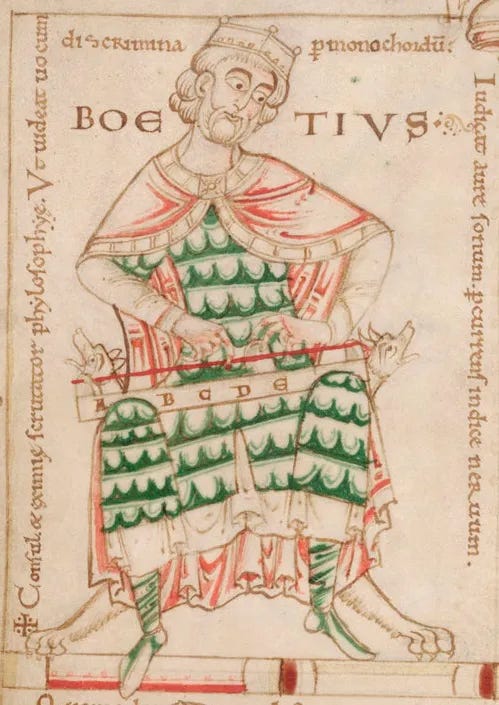
At a Glance: Music isn’t just sound. It’s the secret architecture of the universe.
Music isn’t just an art form to be admired and enjoyed at a distance. Rather, it’s something more like a profound force, something woven into the fabric of our very being and into the cosmos that surrounds us.
Even if we tried to reject or ignore it, its presence in our lives, consciously or unconsciously, remains unavoidable.
This, or something very close to it, is the point made by Boethius, a Roman philosopher and statesman of the early 6th century whose work bridged classical thought and medieval philosophy. In the opening chapter of his Fundamentals of Music, he writes:
“it appears without doubt that music is so naturally united with us that we cannot be free from it even if we so desired.”
Given this all-encompassing influence of music on human life, it stands to reason that:
“the intellect ought to be summoned, so that this art, innate through nature, might also be mastered, comprehended through knowledge.”
And that, in a nutshell, is what Boethius takes the following 200 pages of his dense and almost entirely theoretical text to explore.
On this quest to understand the nature of music, Boethius turns to Pythagoras as his guiding figure, drawing on the ancient philosopher’s belief that music, when you think about it, is really all about numbers.
Here’s how I think it works.
When things—say a drumstick, or a string—move or bump into each other, they make sounds. The pitch of these sounds depends on the frequency of vibrations: faster vibrations produce higher pitches, slower vibrations produce lower ones.
The relationships between pitches, in turn, can be expressed using simple numerical ratios, such as 2:1 or 3:2, which correspond to musical intervals like the octave and the fifth.
Music turns out to be all about numbers, then, and it is only through understanding these numbers that, for Boethius, we can come towards an appreciation of the unchanging essence of music.
For a non-mathematician like myself, this mathematical view of music is interesting for one main reason. By understanding music as the science of numerical ratios, an ordered and proportional relationship among parts, Boethius is able to expand the definition of music to encompass something beyond the field of audible sound itself.
This brings him to divide music into three distinct types: musica mundana, musica humana, and musica instrumentalis.
Musica Instrumentalis is essentially the music we actually hear. It is the sound produced by voices, instruments, and other vibrating bodies. But for Boethius, it is also the least important, as it is simply the outward expression of deeper, more abstract harmonies.
Musica Humana refers to the internal music of the human being. It is the harmony between body and soul, reason and emotion. A well-ordered life or a virtuous soul, in Boethius’s view, reflects a kind of inner musical harmony. As he asks:
“what unites the incorporeal nature of reason with the body if not a certain harmony and, as it were, a careful tuning of low and high pitches?”
Musica Mundana is the broadest definition of music, and it relates to the “music of the spheres” or the cosmic music that governs the movements of celestial bodies. The moon’s rotation around Earth, the Earth’s rotation around the sun, the combinations of the elements, the diversity of the seasons and the essential harmony of the universe.
Though inaudible to the human ear, this type of music reflects the divine order and balance of the cosmos, which mirrors the same mathematical relationships found in audible music.
For Boethius, then, music is not primarily an art form or performance, but a mathematical and philosophical discipline. He invites us to consider it not as cultural expression but as a reflection of cosmic and human order, a bridge between the mind, the body, and even the universe itself.
Extract of the Week #philosophy
Kierkegaard articulates that feeling of estrangement that gets at us all from time to time:
‘One sticks one’s finger into the soil to tell by the smell in what land one is: I stick my finger into existence - it smells of nothing. Where am I? Who am I? How came I here? What is this thing called the world? What does this world mean? Who is it that has lured me into this thing and now leaves me there?.... How did I come into the world? Why was I not consulted .... but was thrust into the ranks as though I had been bought of a kidnapper, a dealer in souls? How did I obtain an interest in this big enterprise they call reality? Why should I have an interest in it? Is it not a voluntary concern? And if I am compelled to take part in it, where is the director?....Whither shall I turn with my complaint?’
Søren Kierkegaard, Repetition, 1843
Image of the Week #history #anthropology
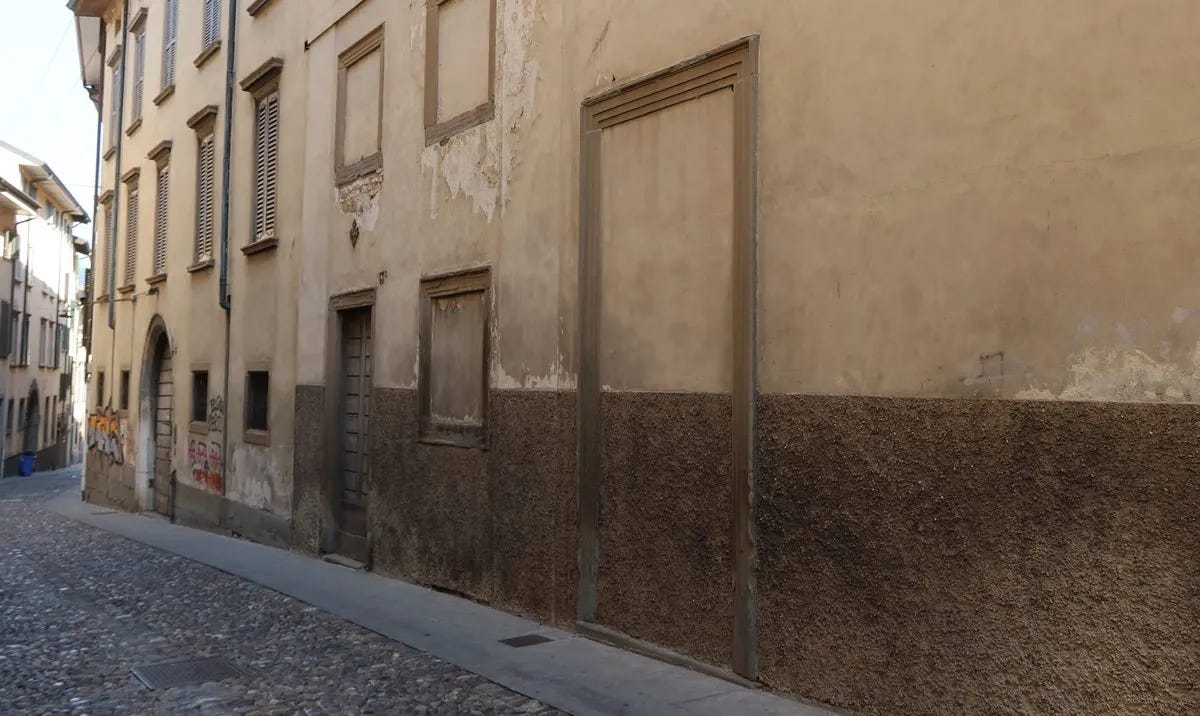
As you wander the cobbled streets of Bergamo, Gubbio or other medieval Umbrian towns, you’re likely to encounter mysterious walled up doors like the one pictured above. They come in different shapes and dimensions but are usually narrow, adjacent to the larger main entrance, and raised just above the street level.
These are known as porta del morto, or doors of the dead.
Behind these doors is a long staircase leading, without any corners, directly to the living quarters. There are practical explanations for the existence of these doors and staircases - security, for example - but over time they took on a new significance.
Upon the death of a family member, the straight staircase offered a convenient route for a coffin to be carried unimpeded from living space to the waiting funeral cart outside, thus avoiding the use of the main entrance, which was reserved for the living. This separation became not just practical but steeped in superstition, reflecting a belief that the dead should not reenter through the same doorway used by those still among the living.
After the funeral, the door would often be permanently sealed, leaving behind a wonderfully eerie architectural mystery which, for those who take the time to look, offers a glimpse into the spiritual traditions and rituals of the medieval world.
The Collection: Dreaming with Fernando Pessoa #literature
Source: The Book of Disquiet by Fernando Pessoa
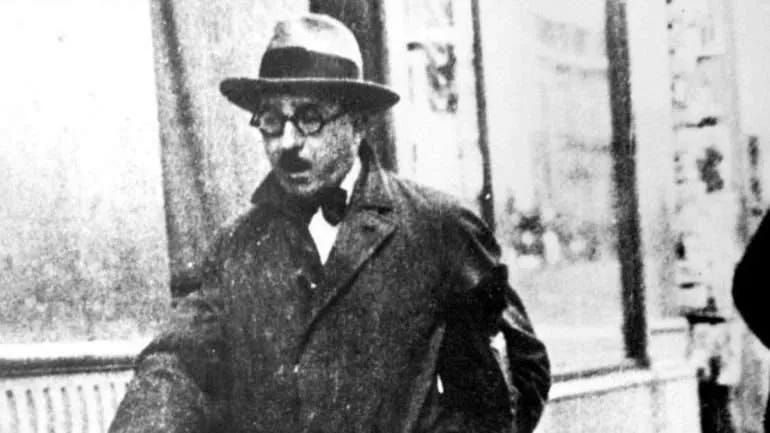
I’ve always chosen to read The Book of Disquiet, the fragmentary collection of musings from the great Portuguese poet Fernando Pessoa, as a manual for dreaming, a how-to-guide for those of us seeking refuge from the real world of responsibilities in an alternate world of imagination. Most of the pages I have marked in my copy relate to dreams and dreaming: here’s some favourite snippets:
“I’ve never done anything but dream. This, and this alone, has been the meaning of my life. My only real concern has been my inner life. My worst sorrows have evaporated when I’ve opened the window on to the street of my dreams and forgotten myself in what I saw there. I’ve never aspired to be more than a dreamer. I paid no attention to those who spoke to me of living. I’ve always belonged to what isn’t where I am and to what I could never be. Whatever isn’t mine, no matter how base, has always had poetry for me.”
“The dreamer isn’t superior to the active man because dreaming is superior to reality. The dreamer’s superiority is due to the fact that dreaming is much more practical than living, and the dreamer gets far greater and more varied pleasure out of life than the man of action. In other and plainer words, the dreamer is the true man of action.”
“I’m a well of gestures that haven’t even all been traced in my mind, of words I haven’t even thought to form on my lips, of dreams I forgot to dream to the end.”
“When all by myself, I can think of all kinds of clever remarks, quick comebacks to what no one said, and flashes of witty sociability with nobody. But all of this vanishes when I face someone in the flesh: I lose my intelligence, I can no longer speak and after half an hour I just feel tired. Yes, talking to people makes me feel like sleeping. Only my ghostly and imaginary friends, only the conversations I have in my dreams, are genuinely real and substantial, and in them intelligence gleams like an image in a mirror.”
“With merely a kind of smile in my soul, I passively consider the definitive confinement of my life to the Rua dos Douradores, to this office, to the people who surround me. An income sufficient for food and drink, a roof over my head, and a little free time in which to dream and write, to sleep – what more can I ask of the Gods or expect from Destiny?”
“If there’s any justice in the Gods’ injustice, then may they let us keep our dreams, even when they’re impossible, and may our dreams be happy, even when they’re trivial. Today, because I’m still young, I can dream of South Sea islands and impossible Indias. Tomorrow perhaps the same Gods will make me dream of owning a small tobacco shop, or of retiring to a house in the suburbs. Every dream is the same dream, for they’re all dreams. Let the Gods change my dreams, but not my gift for dreaming.”
“In my dreams I’ve sometimes tried to be the unique and imposing individual that the Romantics envisaged in themselves, and I always end up laughing out loud at the very idea. The ultimate man exists in the dreams of all ordinary men, and Romanticism is merely the turning inside out of the empire we normally carry around inside us. Nearly all men dream, deep down, of their own mighty imperialism: the subjection of all men, the surrender of all women, the adoration of all peoples and – for the noblest dreamers – of all eras. Few men devoted, like me, to dreaming are lucid enough to laugh at the aesthetic possibility of dreaming of themselves in this way.”
“Everything useful and external tastes frivolous and trivial in the light of my soul’s supreme reality and next to the pure sovereign splendour of my more original and frequent dreams. These, for me, are more real.”
“A breath of music or of a dream, of something that would make me almost feel, something that would make me not think.”
“My hapless peers with their lofty dreams – how I envy and despise them! I’m with the others, with the even more hapless, who have no one but themselves to whom they can tell their dreams and show what would be verses if they wrote them. I’m with these poor slobs who have no books to show, who have no literature besides their own soul, and who are suffocating to death due to the fact they exist without having taken that mysterious, transcendental exam that makes one eligible to live.”
“There are times when dreaming eludes even me, an obsessive dreamer, and then I see things in vivid detail. The mist in which I take refuge dissipates. And every visible edge cuts the skin of my soul. Every harsh thing I see wounds the part of me that recognizes its harshness. Every object’s visible weight weighs heavy inside my soul.”
“Sometimes I muse about how wonderful it would be if I could string all my dreams together into one continuous life, a life consisting of entire days full of imaginary companions and created people, a false life which I could live and suffer and enjoy. Misfortune would sometimes strike me there, and there I would also experience great joys. And nothing about me would be real. But everything would have a sublime logic; it would all pulse to a rhythm of sensual falseness, taking place in a city built out of my soul and extending all the way to the platform next to an idle train, far away in the distance within me… And it would all be vivid and inevitable, as in the outer life, but with an aesthetics of the Dying Sun.”
“I’ve dreamed a great deal. I’m tired from having dreamed but not tired of dreaming. No one tires of dreaming, because dreaming is forgetting, and forgetting doesn’t weigh a thing; it’s a dreamless sleep in which we’re awake. In dreams I’ve done everything.”
“My imaginary excursions, my outings in a countryside that never existed! The trees along the roadside, the pathways, thenstones, the rural folk passing by – all of this, which was never more than a dream, is recorded in my memory, where it hurts, and I, who spent so many hours dreaming these things, now spend hours remembering having dreamed them, and it’s a genuine nostalgia that I feel, an actual past that I mourn, a real-life corpse that I stare at, lying there solemnly in its coffin.”
“I am nothing. I’ll never be anything. I couldn’t want to be something. Apart from that, I have in me all the dreams in the world.”
All new stuff next time. Until then, be well!
Thanks again for the Parfit and hope next week is less troublesome for you.