
Archive Issue
Metaphors, Wellbeing, Instant Gratification, Mandelas, Akan Proverbs

This week’s issue was to concern itself with shadow in Japanese architecture and Molinos on silence. This week’s issue, I'm afraid, does not exist.
Between intention and execution fell a viral infection of enough tenacity to fell the full household for the full week.
In its place, then, some pieces from the archive, selected with as much curational judgement as I can currently muster. Normal service will return when the household achieves collective verticality.
Thanks for your patience.
What you’ll get:
From Issue #9: Lakoff on Metaphor
From Issue #13: Nussbaum on Wellbeing
From Issue #18: Bernstein on Instant Gratification
From Issue #10: Jung on Mandelas
From Issue #14: Akan Proverbs
Is Our Conceptualisation of the World Affected By the Language We Use to Describe It? Lakoff and Johnson on the Metaphors We Live By #linguistics
I want to spend some time this week exploring George Lakoff and Mark Johnson’s ideas about how we use and interpret metaphors. And before you protest that you last thought about metaphors under the instruction of your high school English teacher, I’d like to kick off by suggesting that their use extends way beyond the domain of literature and that, in fact, our use of metaphor penetrates our daily discourse to a degree not often appreciated.
Not convinced? Well, I reckon I’ve used as many as ten in those two opening sentences.
When I say that I’m spending time, I’m drawing on a common metaphor that conceptualises time as money. When I suggest that I’m exploring an idea, said idea becomes undiscovered territory to be traversed by a kind of cognitive Columbus. Even the verb use constructs a metaphor in the sense that I’m drawing a comparison between a linguistic device and a tool with a specific function that can be deployed in the service of achieving some sort of communicative aim.
Your counter-argument is a protest, your teacher has been figuratively positioned in a spatial relationship above that of the mere student, my article kicks off as though it’s some sort of sports fixture, the domain of English literature is serving as a kind of container that houses literary constructions, the metaphor itself is personified as an entity with an agency that allows it to penetrate and, by deploying the word degree, I’m measuring societal metaphor adoption with some sort of linguistic thermometer.
I hope I’ve made my point. They. Are. Everywhere. And we need to understand better how our pervasive use of them can influence the way in which we think about the world around us.
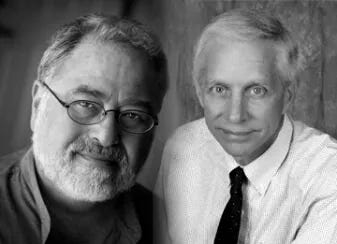
This is what Lakoff and Johnson’s 1980 book Metaphors We Live By sought to do, and the central thrust of their argument is that metaphors are a lot more than just useful tools to help us communicate our ideas creatively. They are more than just poetry. They are central to the way in which we see the world, central, even, to the development of thought itself.
It might be useful at this point to define exactly what a metaphor is.
Humans deploy the metaphor to help us visualise an idea. We view a thing in terms of another thing. We map something complex onto something more simple. Usually, one side of a metaphor is something that is abstract in nature and therefore difficult to understand. Time, for instance. The other side of the metaphor is usually something concrete, something with a physical presence in the real world and is therefore easier to visualise and understand. Like money.
Life is a journey. The mind is a machine. Dealing with a potentially terminal illness is a battle. The economy is a rollercoaster. These metaphors not only help us to better understand the complex or abstract thing but, for Lakoff and Johnson, they, at least to some degree, also help to shape our understanding of it.
Let’s take an intellectual debate as an example. The underlying metaphor that is so often at play in our linguistic framing of the activity is that of a war or struggle. We win arguments. We might spot weak points in the arguments of others and shoot them down. We might even say the claims of our interlocutor are indefensible.
But this linguistic framing is not neutral. It colours the way we think about the process of debate and often prevents us from conducting a collaborative, constructive argument that could move forward our thinking about a certain subject.
What about the mind as a machine? We might be feeling rusty, we might talk about how we need to plug-in to a conversation, we might suffer a breakdown. Again, these aren’t neutral constructions. If we’re struggling with our mental health, this pervasive metaphor might lead us into thinking we are somehow faulty and that we have to take our brain to a specialist who will fix us. Failure to repair our mind quickly and efficiently might lead us into thinking we are somehow wired wrong or that we are fundamentally broken.
Routinely thinking of time in terms of money - I’ve invested a lot of time in this, let me save you some time, I don’t want to waste your time - risks prioritising productivity and efficiency over all other concerns, encouraging us to maximise every moment for economic benefit. Can pausing for thought not also be a valuable endeavour?
Another very common metaphor is the one that conceptualises life as a journey from A to B. I’m on the right path. I’m at a crossroads. I’m going off track. I’ve taken a wrong turn. I’m moving forward with this plan. I’ve come a long way. He’s going places. She’s lacking direction. We think of relationships in the same terms. We’re on different paths. Where is this going? This marriage is on the rocks.
The danger here is that a failure to describe a desired destination that a life is pointing towards, or a failure to evidence some sort of forward motion in the direction of that destination, can have profoundly unsettling consequences for our measurement of success and happiness.
It doesn’t have to be like this. What, when you think about it, is really wrong with staying where we are? Do we need that bigger house? Must we strive for that promotion? For many of us, such striving is a positive and productive thing, but for many more people right-where-we-are is exactly where we should be.
Now, Lakoff and Johnson don’t just diagnose a problem, but actually put forward the beginnings of a solution. The solution, quite satisfyingly, resides in human creativity.
For them, truly creative use of metaphor helps us to think about a concept in a totally new way, to visualise it differently and therefore understand it differently. They offer an example of a relationship being like a collaborative art project rather than the aforementioned journey. Thinking in these terms brings to the fore the idea that a relationship is something that requires work, something that is active, requiring dialogue and cooperation, requiring patience. It is unique. It encourages us to think that a successful relationship cannot be realised by simply putting one foot in front of another or applying a predetermined formula.
It strikes me that such a metaphor is also likely to help us re-evaluate those relationships that come to an end. If a relationship is a journey then every relationship that fails to reach its destination, even those that last 40 years, has in some important respect failed. A collaborative art project, on the other hand, can be erected, admired, disassembled and live on in the memory as something that was beautiful and brightened a small corner of the world, however briefly.
If you’re feeling like you’re lacking direction at the moment or that you’ve taken a wrong turn, maybe your career path isn’t progressing in the way you intended or you’ve been through a few dead-end jobs lately, take a moment to stop and ask yourself if you’re thinking about your life with the right conceptual framework. Maybe life doesn’t have to be a journey powered by a perpetually progressing forward motion, maybe it’s a dance, or a puzzle, or a garden to be tended to.
The point isn’t that one metaphor is the right one. The point is that Lakoff and Johnson help us to be alive to the metaphors we routinely use without recognising that that’s what we’re doing. If we can do that, we can be empowered to select new metaphors if the old ones aren’t working.
Word of the Week: What Does Wellbeing Really Mean? Martha Nussbaum’s Framework for Human Flourishing
We have annual wellbeing days at my place of work. It’s a day where we can finish our productive endeavours at lunchtime on the condition that we sign up to various activities designed to improve our wellbeing. Such activities have in the past included pottery, yoga, escape rooms, team building games, vegan cookery workshops and zumba classes.
Now, I’m not one to complain about an early finish, and I very much enjoyed the ‘quiet reading space’ I signed up to last year, but it strikes me that, as a culture, we could really do with sharpening up our definition of ‘wellbeing,’ given that it’s what we’re all striving for in one way or another.
One interesting approach comes from Martha Nussbaum who, in Women and Human Development: The Capabilities Approach (2000) sought to set out a view of wellbeing that would transcend cultural and religious boundaries.
She takes Amartya Sen’s distinction between functionings and capabilities as a starting point. Functionings, in this view, refer to the actual things a person manages to do or be in life. I might be a moderately good amateur tennis player and do a serviceable ragu, for example.
Capabilities, on the other hand, refer to the real opportunities or freedoms a person has to achieve the functionings they value. Capabilities are about what is possible rather than what is actually achieved. My ability to function as an amateur tennis player (I’m really overstating my talents now) relies on my freedom to access the necessary courts and equipment, whilst my ragu has been the result of years of experimentation in a kitchen of my own, with ingredients and utensils bought with money that I’ve been free to earn etc. etc.
But capabilities are not necessarily neutral. The question arises of what it is we should be capable of doing, because surely we need to draw up some boundaries somewhere? I might be capable of eating my body weight in digestive biscuits but it doesn’t strike me as a particularly good measure of my quality of life.
One of Nussbaum’s main departures from Sen’s work, then, is in her spelling out of exactly what our necessary capabilities should be and her suspiciously round-figured list of ten can serve as a useful framework for evaluating wellbeing, regardless of divergent cultural dimensions at a local level.
Life – our capability to live to an adequate age.
Bodily Health – our capability to live a healthy life, including adequate shelter, reproductive health and nourishment.
Bodily Integrity – our capability to move freely, be safe from violence, and make decisions about our own bodies.
Senses, Imagination and Thought – our capability to think, imagine, create, informed by a satisfactory education.
Emotions – our capability to form attachments to things outside of ourselves. Empathy, love, grief.
Practical Reason – our capability to make our own decisions regarding the life we want to live and to critically reflect on it.
Affiliation - our capability to live in harmony with others, form social relationships, and be treated with dignity and respect.
Other Species - our capability to live in relation to, and show concern for, the environment and other living species.
Play - our capability to enjoy recreation, leisure, and play.
Control over One’s Environment - our capability to participate effectively in political life and to own our own property.
That’ll just about cover our universal pursuit of human functioning. We’re striving, says Nussbaum, to be healthy and free. Free from violence, free to think, free to live in harmony with the world and the people in it, free to construct our own existence rather than having it shaped by others.
I can’t say I’ve read the text cover to cover, but I’m fairly confident that compulsory Zumba classes aren’t a part of the framework.
Extract of the Week #cultural studies #sociology #art
Visual culture, scroll-speed ‘content’ and six-second video platforms are crippling our attention spans, but this was something Leonard Bernstein was lamenting years before we gave our lives over to the algorithm.
Here he is in Dinner with Lenny: The Last Long Interview with Leonard Bernstein by Jonathan Cott, published in 2012, talking about the impact of the Atomic Bomb on our cynicism and desire for instant gratification.
‘But the point I want to make is that anybody who grows up-as those of my generation did not-taking the possibility of the immediate destruction of the planet for granted is going to gravitate all the more toward instant gratification-you push the TV button, you drop the acid, you snort the coke, you do the needle. It doesn’t matter that it makes you impotent. You’ve gotten so high and then you pass out in the bed...and you wake up so cynical. The girls wake up unsatisfied, and the boys wake up guilty and ashamed and full of manic fears and anxiety...and guilt breeds fear and anxiety, and anxiety breeds fear, and it goes around-it’s that old vicious circle where one thing reinforces the other, which drives you day and night to instant gratification. Anything of a serious nature isn’t “instant”-you can’t “do” the Sistine Chapel in one hour. And who has time to listen to a Mahler symphony, for God’s sake?
[...]
So that’s what I was trying to say before about learning and instant gratification. [L.B. grabs hold of my cassette tape recorder.] You’ve got that? You’ve got that, little machine? You can’t “do” the Sistine Chapel instantly-you have to lie on your back and look up at that ceiling and con-template. And we’ve already lost a whole generation of kids who are blind to anything constructive or beautiful, who are blind to love, love, LOVE-that battered, old, dirty four-letter word that few people understand anymore.’
Image of the Week #psychology #art
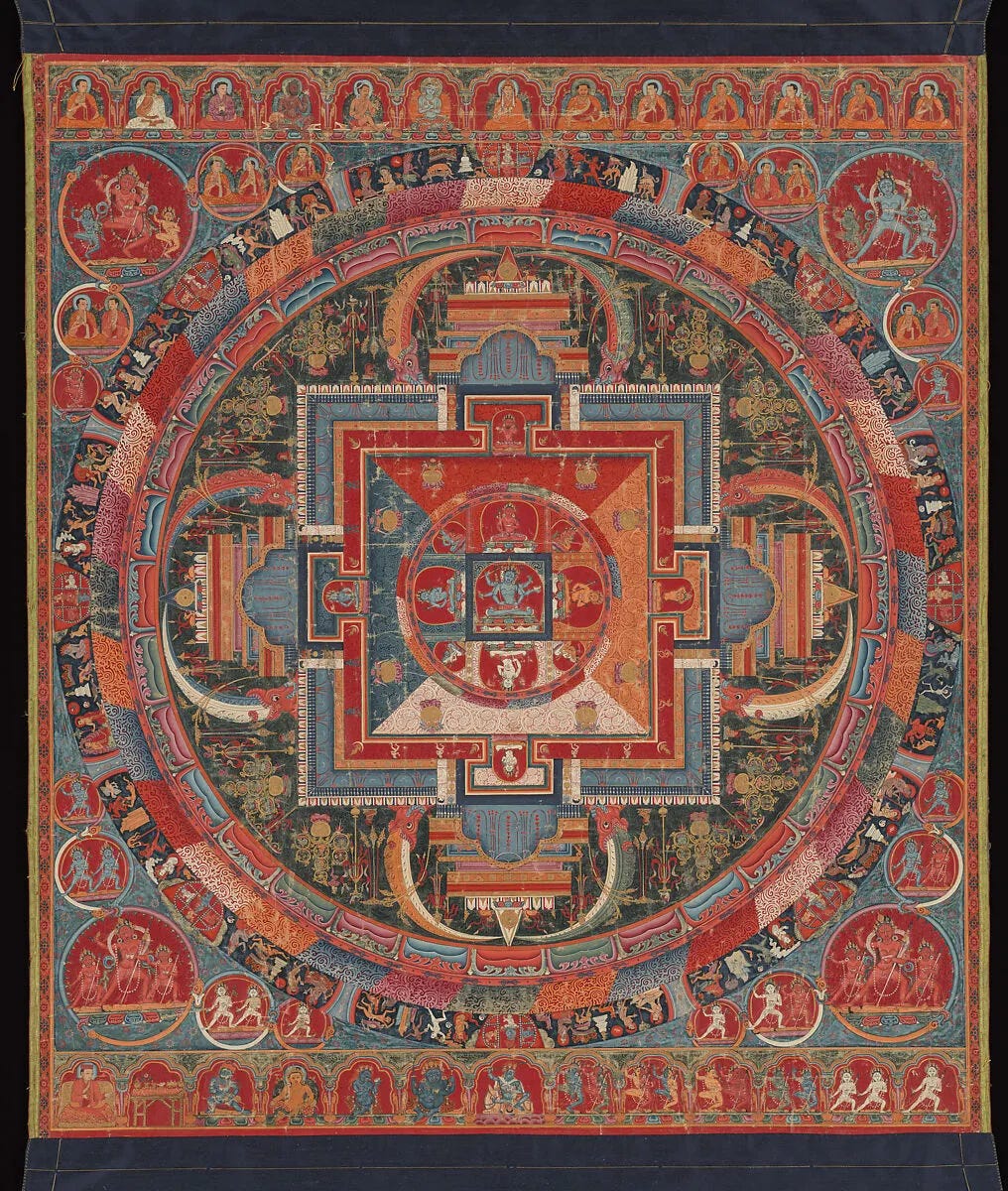
Mandala of Jnanadakini, Tibet, late 14th century
The concentric symmetry of a mandala is strangely seductive. Its intricate patterns seem to exist apart from humankind, as though created by the universe itself as a clue or a puzzle; something that hints at secrets but doesn’t really reveal them, something that promises guidance. Like a map of an old town, it draws you inevitably into its centre, a journey inward towards the still point in a turning world.
Carl Jung certainly found them captivating and, never a man to leave a puzzle unsolved, he had all sorts of fascinating ideas about their significance.
For him, a mandala was a symbolic representation of the self, a specific centre of the personality not to be confused with the ego:
‘The self, though on the one hand simple, is on the other hand an extremely composite thing, a “conglomerate soul,” to use the Indian expression.’
They symbolise, for Jung, a kind of central point within the psyche, like a hub within our mind where everything connects and gets organised. This center isn’t just a focal point; it’s also a source of energy that influences everything around it:
‘The energy of the central point is manifested in the almost irresistible compulsion and urge to become what one is, just as every organism is driven to assume the form that is characteristic of its nature, no matter what the circumstances.’
I like this, as a concept. At our core we are quintessentially our true selves - quiet, still and grounded - but our character also comprises a periphery of paired opposites that make up our complete personality.
Herein lies the comforting aspect of mandalas for me. I can, after all, claim to love people whilst wanting to be on my own, claim to have a discerning relationship with culture whilst watching another rerun of Friends, claim to appreciate the beauty of the natural world whilst keeping my curtains closed until lunchtime.
The Collection | African Wisdom #philosophy
Akan proverbs are a rich and largely underexplored repository of wisdom, offering insights into the values, beliefs, and traditions of the Akan people of Ghana and Côte d’Ivoire. Passed down through generations, these sayings use metaphor and symbolism to teach lessons on morality, resilience, and communal living. Here’s a few of my favourites. Credit here to adinkrasymbols.org for the translations (https://www.adinkrasymbols.org/pages/the-50-most-important-akan-proverbs/)
The Earth has weight : Symbol of providence and the divinity of Mother Earth. This symbol represents the importance of the Earth in sustaining life.
1.
Anomaa antu a, obua da (If a bird does not fly, it goes to bed hungry)
Nothing ventured, nothing gained. The bird must take the risk if it is to find food to eat.
2.
Okoto nwo anomaa (A crab does not give birth to a bird)
A more colourful version of the English ‘an apple doesn’t fall far from the tree’
3.
Nyansapo wosane no badwemma (Wise knots are loosened by wise men)
Delicate matters require the attention of those with wisdom
4.
Yewo wo to esie so a, wonkye tenten ye (If you are born unto a mound, it does not take you long to grow tall)
Being born into wealth is a good path to wealth in later life. Advantages of birth have a habit of persisting.
5.
Yesoma onyansofoo, enye anamontenten (We send a wise person, not one with long legs)
There is more to communicating a message, or getting a job done, than speed.
6.
Obi nnim oberempon ahyeasee (Nobody knows the beginning of a great man)
So don’t pre-judge those from humble birth
7.
Abe bi rebewu a na eso (It is when some palm trees are about to die that they give the best wine)
Pay heed to the wisdom of those who have lived.
All new stuff next time Until then, be well!
I hope this comment finds you and your family vertical and well again.
They say that if we want to change the world, we have to describe it differently—the rest will follow. We might say the same about ourselves. To state “no man is an island” fixes an image in my mind of an individual as an island (don’t think about an elephant). Remote, apart, and alone—like Man Friday before he was rescued by another individual with more privilege, power, and agency.
If I imagine myself as a set of nested concentric circles, I think of an onion, an egg, or a fortress with defensive walls. If I imagine myself as part of a web, a pick‑a‑path story, a tendril in a layer of matted roots, or a point in one of the countless, shape‑shifting constellations in an infinite sky, I become a different fish in a different kettle.
As the Native American and Canadian writer Thomas King says in his 2003 CBC Massey Lectures, The Truth About Stories: A Native Narrative: “The truth about stories is that that’s all we are.”
Thanks for this update, hope you're better soon! Seriously though, how do you always manaj to dig up such amasing old posts?